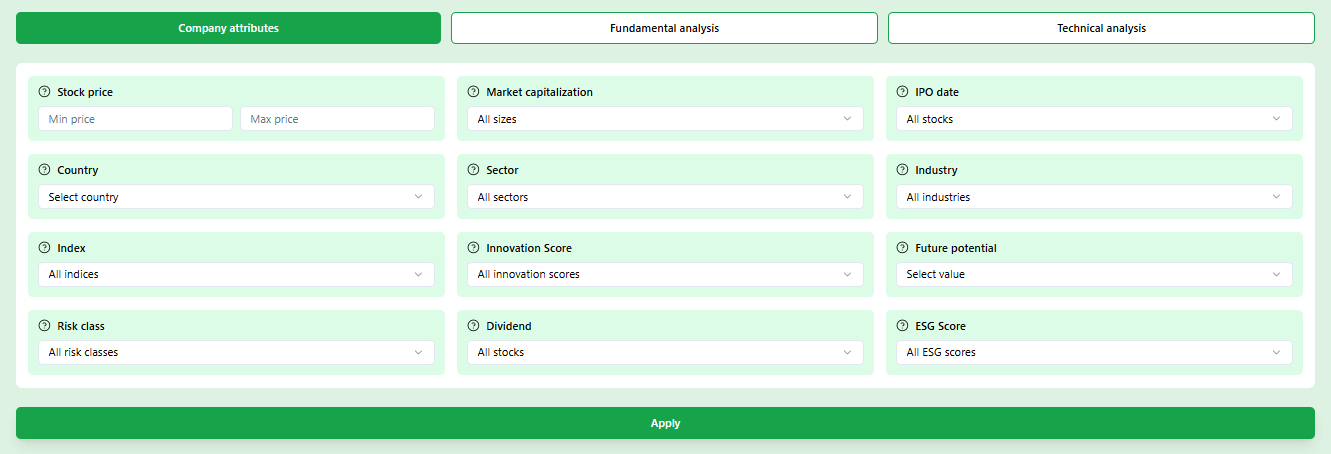
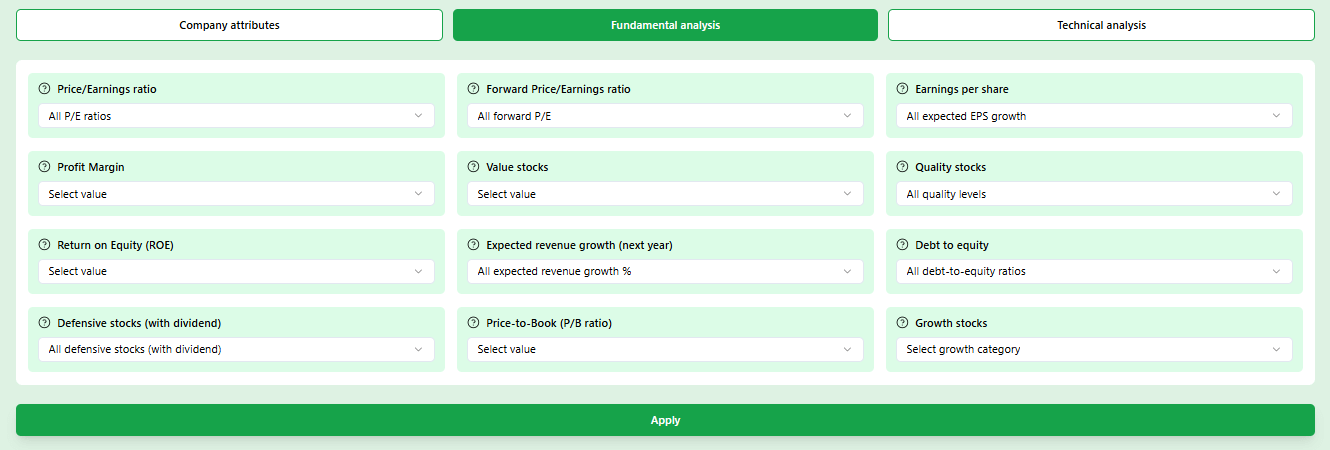
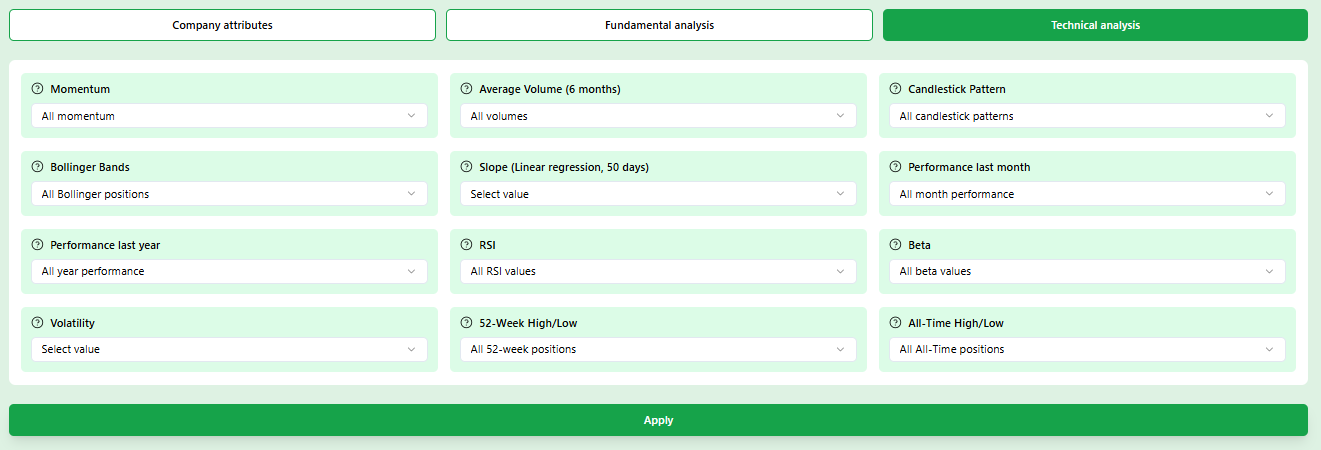
AI stock pickers apply a scoring model to 25,000 companies and surface the ones that match your criteria. The same result is available through a transparent filter system. You keep control, you see the reasoning, and you decide.
✓ Free to start · ✓ No credit card needed · ✓ 25,000 stocks available
What AI stock pickers are actually doing under the hood
An AI stock picker does not think the way a human analyst does. It scores companies against a predefined set of financial parameters: valuation ratios, profitability metrics, debt load, revenue trend. It then ranks the results. That is the complete logic.
The intelligence is in the filter design, not the algorithm itself. Which parameters matter, how they are weighted, and what thresholds make sense for your strategy: those decisions are made by a human before the AI touches a single data point. Belegget exposes that layer directly. You set the rules, the engine does the sorting.
Every filter is visible and adjustable
Results show exactly which criteria each stock met
No hidden weighting or opaque scoring
Answer a few questions and receive a personalized shortlist
Not every investor knows which metrics to use on day one. The Smart Filter asks about your goals instead of your knowledge. What type of company? What holding period? What phase of growth?
From your answers, the system constructs the right filter combination and returns a shortlist from 25,000 companies. The same logic a portfolio manager would apply manually, translated into a three-question flow.
Set the parameters, skip the algorithm
Value investors need P/E Ratio and Price-to-Book. Growth investors need EPS growth and Expected revenue growth. Dividend investors need Dividend yield alongside Debt-to-Equity. All three profiles have their own filter combination, and all three are available without any subscription.
P/E Ratio below 20
Filters for reasonably valued companies
Market cap between $2B and $10B
Mid-cap focus with room to grow
Country selection
Regional focus or global diversification
How an AI stock picker makes its decisions and how to replicate it
Behind every AI stock recommendation is a scoring model. It assigns a weight to each financial metric and calculates a composite score per company. A high P/E Ratio lowers the score. Strong revenue growth raises it. A clean balance sheet adds to it. The company with the highest total score gets recommended.
That is not fundamentally different from setting three filters manually and looking at the companies that pass all three. The structural logic is identical. What differs is transparency: with a manual filter, you know exactly what "qualified" means. With an AI recommendation, you do not. For investors who want to understand their portfolio, that distinction matters considerably.
The black box problem with AI stock pickers
An AI gives you a stock. It does not give you a reason. You receive a ticker symbol and perhaps a confidence score, but the weighting behind that score is proprietary. You cannot verify whether the recommendation reflects your actual investment thesis or whether it was influenced by a pattern that does not apply to your situation.
This creates a specific risk: you end up with a portfolio you cannot explain to yourself. When a position moves against you, you have no basis for deciding whether the thesis is broken or the market is just volatile. Transparent filtering eliminates that problem entirely. If a stock no longer passes your criteria, the screener will show it. You never have to guess.
36 filters versus 1 algorithm: which gives you more control?
An algorithm is a predefined combination of parameters. When you use an AI stock picker, someone else decided which metrics matter and how much weight each one gets. Those decisions were made for a general audience, not for your specific investment thesis.
With 36 individual filters, you construct the logic yourself. A European dividend investor combining Dividend yield above 3 percent, Debt-to-Equity below 1.0, and Sector set to Utilities is building a systematic strategy that reflects exactly what they are trying to achieve. That combination would not exist as a preset in any AI tool.
The result of running that combination against 25,000 stocks is typically 15 to 40 companies. Every single one passed your rules. That is what the algorithm was meant to deliver, but rarely does with this level of specificity.
The Smart Filter: your investment strategy, systematized
The appeal of an AI stock picker is that it does the thinking for you. The Smart Filter achieves the same outcome through a different mechanism: it asks you three to five questions about what you are trying to achieve, then constructs the right filter combination automatically.
What type of company? Which holding period? What risk level? Those three inputs are enough to distinguish between a conservative European dividend portfolio and an aggressive US growth focus. The filter logic differs substantially between the two, but neither requires the user to understand a single financial metric before starting.
From 25,000 stocks to your shortlist in four steps
The pipeline below is what Belegget runs every time you apply a filter. Raw market data across 25,000 companies enters the filter layer. Each stock is tested against your active parameters. Companies that clear every threshold pass the pattern match. The rest are excluded.
The output is a shortlist of stocks that met every one of your criteria simultaneously. Not just one filter and not most of them. All of them. That precision is what makes the result useful rather than a list of 800 vaguely relevant companies.
First results in five minutes, regardless of experience level
Create a free account and the screener is available immediately. No onboarding form, no paid trial required. Open the Smart Filter, answer the three questions, and the first shortlist appears within about a minute of your first login.
From that point, you can refine: add a Country filter to focus on European companies, adjust the P/E threshold to 12 instead of 20, or switch the sector from Technology to Consumer Staples. Each change updates the results instantly. The screener shows how many companies remain after each adjustment, which gives you a clear sense of how tight or loose your criteria are before you commit to a list.
Frequently asked questions about AI stock pickers
Practical answers for investors comparing their options
More screener guides for private investors
Each guide covers a different approach to finding stocks. Together they form a practical toolkit for building a systematic investment process.
Custom Stock Screener
How to build a screener setup that matches your specific strategy rather than using a generic template.
Simple Stock Screener
The fastest way to go from no filters to a useful shortlist, using two or three criteria that actually work.
Stock Screener
A full overview of how stock screeners work, what to filter for, and which settings to use for different investment styles.
Find your next stock with a system that shows its work
25,000 stocks. 36 filters. A guided quiz that turns your goals into a shortlist. Free to start, no credit card required.