Most people who want to start investing get stuck before they buy a single share. Not because markets are too complex, but because the tools available assume you already know what you are doing. Belegget is built differently: a guided questionnaire that asks the right questions for you, simple filters that explain themselves, and a watchlist that teaches you what to pay attention to over time.
✓ No credit card · ✓ Free to start · ✓ No experience needed
The questionnaire asks the questions you do not yet know to ask
One of the things that makes this one of the best stock research tools for beginners is the guided questionnaire. Rather than forcing you to choose filters cold, it starts with three questions about your situation: how long you want to hold, what kind of company appeals to you, and what growth phase fits. The platform translates those answers into a filter setup and returns a list of matching companies. You get a starting point without needing any background knowledge.
No setup knowledge required
The questions are about your goals, not about financial metrics
Results in under two minutes
A shortlist of relevant companies before you have read a single annual report
Adjust freely afterwards
Add or remove filters once you see the list and want to narrow it further
What actually makes a stock research tool good for beginners?
Not all tools described as beginner-friendly actually are. These four criteria separate the ones that genuinely help from the ones that just have a simpler design.
It guides you before you filter
A tool that starts with 36 blank filters is not beginner-friendly, even if each filter has a tooltip. The best tools for beginners provide a starting point: a questionnaire, a template, or a recommended starting setup. You should not need to know what you want before the tool helps you figure it out.
It explains what you are looking at
Showing a P/E ratio of 14.3 next to a revenue growth of 8% means nothing to someone who does not know what either figure represents. Good beginner tools include short, contextual explanations on the same page as the data. Not in a separate help section. Right there, where you are reading.
It lets you start simple and go deeper later
Beginners do not need all 36 filters on day one. They need two or three that make sense. But the tool should also have the depth for when they are ready. The best research tools for beginners scale with your knowledge rather than locking you into a simplified version forever.
It lets you save and come back
A watchlist is one of the most underrated features for beginners. The ability to save companies you find interesting, then check back on them weekly without redoing the research, is how you actually learn to evaluate stocks. Tools that lack this force you to start over every session.
Start with two or three filters. Not thirty-six.
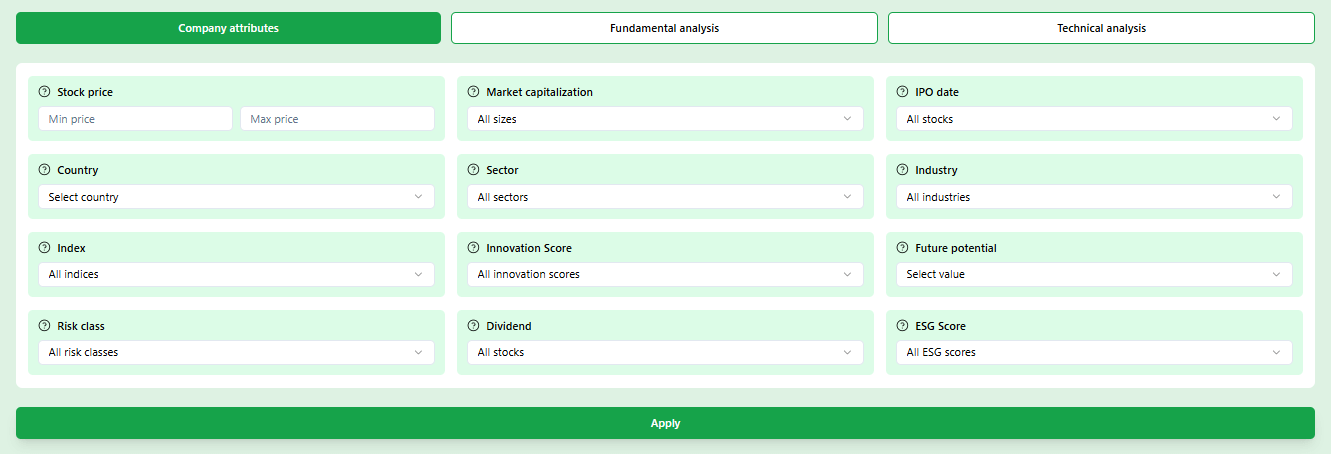
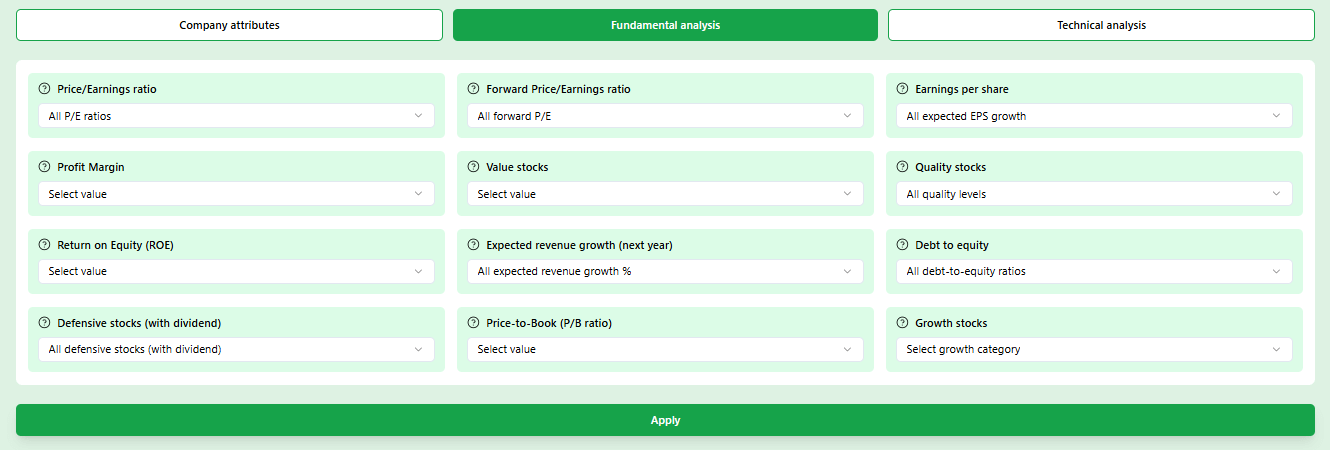
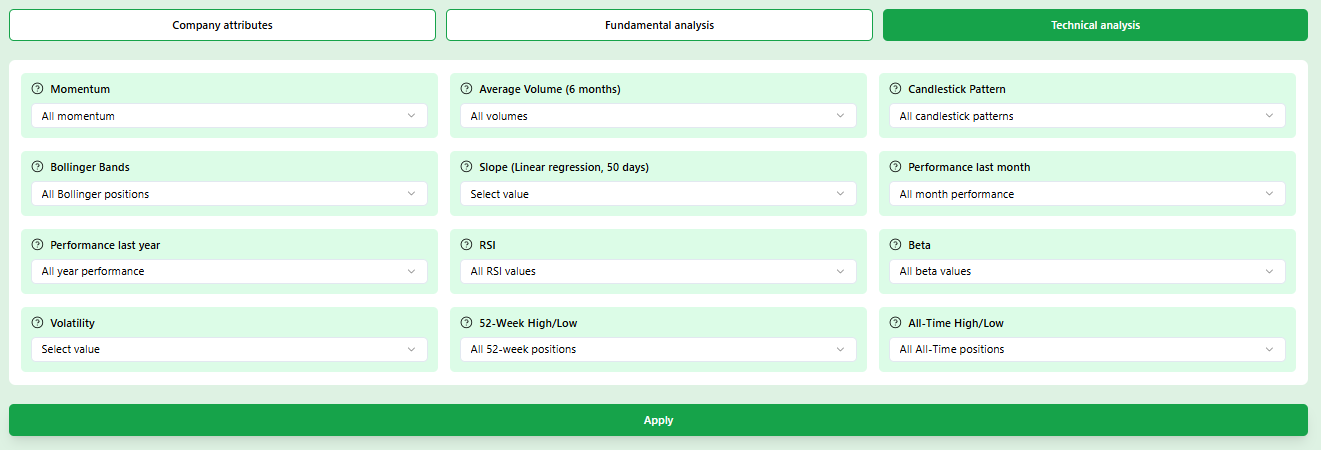
One of the most common beginner mistakes is opening a screener and immediately feeling lost in a wall of filter options. Belegget has 36 filter parameters, but you do not need all of them to get started. The platform is built so you can use two or three to get a meaningful list, see the results, and then layer in more precision once you understand what you are looking at.
Good first filter: dividend yield
Immediately filters for companies that pay income, which is easy to understand as a concept
Good second filter: market cap
Large, stable companies versus smaller, faster-growing ones — a meaningful distinction even for beginners
Good third filter: sector
Invest in industries you already understand from daily life before exploring unfamiliar ones
How beginners typically progress with stock research tools
No one becomes a confident investor overnight. But there is a natural progression that most people follow once they have the right tools available.
Getting your first shortlist
Your first goal is not to find the perfect stock. It is to understand what the tool shows you. Use the questionnaire, get a list of 10 to 20 companies, and spend five minutes on two or three of them. Look at the sector, the size of the company, and whether there is a dividend. Do not try to understand everything at once.
Learning to read one company at a time
Once you have a shortlist, open the company page for one stock you recognize or find interesting. Look at revenue growth over the last three years. Is it going up? By how much? Then check whether the company is profitable and whether it carries a lot of debt. You are not making a decision yet. You are building a mental model of what good numbers look like versus concerning ones.
Building a watchlist and observing
Add five or six companies to your watchlist that passed your initial review. Then wait two or three weeks. Come back and see what has changed. Did the price move? Was there news? Did anything change in the fundamentals? This phase is where most of your learning actually happens, and it costs you nothing because you are not trading yet.
Making your first informed decision
After a few weeks of watching, you will notice that some companies feel more solid to you than others. You will have a reason, even if it is intuitive at first. This is the point where your research starts to inform a real decision. You take that company to your broker, not based on a tip from a forum, but based on weeks of your own observation with real data behind it.
Start researching stocks today, even if you know nothing yet
Create a free account and use the questionnaire to get your first shortlist in under two minutes.
Common mistakes beginners make when researching stocks
Most of these mistakes come from either too little information or too much of it at the wrong time. Good stock research tools for beginners are designed to avoid them.
Filtering too aggressively too fast
Setting six filters on day one often returns zero results. It feels like the tool does not work. In reality, the market just does not have companies that meet every strict criterion simultaneously. Start with two filters and build from there.
Researching individual stocks before building a process
Looking up one specific company you heard about in the news is not the same as having a research process. The best stock research tools for beginners help you build a systematic approach rather than chasing whatever is trending today.
Mistaking a low price for a good deal
A stock at 4 euros is not automatically cheap. Price alone tells you nothing. What matters is the valuation relative to earnings, growth, and assets. This is what fundamental filters help you evaluate, even when you are just starting out.
Expecting results too quickly
Beginners often want to find the right stock in their first session and make a move immediately. The most valuable thing you can do in the first few weeks is build a watchlist and observe. The research comes before the decision.
Only looking at familiar companies
Sticking to brands you recognize limits your options significantly. Many of the most interesting companies for long-term investors are not household names. The sector and country filters help you explore markets you would never have found on your own.
Skipping the watchlist phase
The watchlist is where you learn without financial risk. Adding five companies and observing them for a few weeks teaches you more about how stock prices move in relation to company news and fundamentals than any article could.
Five things beginners actually use these tools for
These are the real workflows that new investors use when they get started with stock research tools for beginners, not the features listed in a spec sheet.
Finding their first list of companies to explore
The very first thing a beginner needs is a starting point. Not the best stocks, not a complete portfolio, just a list of companies worth reading about. The questionnaire produces exactly that. Three questions, two minutes, and you have 10 to 20 companies in sectors that fit your profile. From there, you open a few company pages and start to understand what the numbers mean. That is the whole goal of session one: get a list, look at two or three companies, and close the tab having learned something.
Understanding what a company's numbers actually mean
You open a company page and see revenue growth of 18% year over year, a P/E ratio of 22, and a debt-to-equity ratio of 0.6. If you are new to investing, these numbers are just numbers. The company detail page in Belegget gives each metric a short explanation right beside it. You learn what revenue growth tells you about momentum, what a P/E ratio suggests about how the market values the stock, and what debt levels imply about financial stability. This is how beginners build financial literacy alongside their actual research, not in a classroom but while looking at real companies.
Exploring a sector they already understand
Most beginners are more comfortable starting with industries they interact with in daily life: consumer goods, technology they actually use, or healthcare companies whose products they recognize. The sector filter lets you isolate exactly those industries and build your first shortlist from there. Once you understand how to evaluate a company in a familiar sector, moving into less familiar territories like industrials or energy becomes much less intimidating, because the analytical process is the same even when the business model differs.
Building a watchlist to observe before committing
The watchlist is arguably the most important feature in any stock research tool for beginners, and the most underused. You save five to eight companies that survived your initial filter and company page review. Then you do nothing for two weeks. You come back, see what changed, and ask yourself: did this move the way I expected? Was there news I should have anticipated? Did the numbers hold up? This process of observing without consequences is how you develop intuition for market behavior. When you eventually place a real trade, it will be based on something you have actually watched and thought about.
Getting notified when something changes on a company they are watching
One of the practical challenges for beginners is remembering to check back. You add a company to your watchlist and then forget about it for three months because nothing prompted you to look. The alert system solves this. When something notable changes on a company you are following, whether it is a fundamental update or a price movement that crosses a threshold you care about, you get a notification. This keeps your research active without requiring you to manually review every company every week. For beginners who are still building the habit of regular research, this kind of prompt makes a real difference.
Frequently asked questions
The best time to start learning to research stocks is now
Create a free account, use the questionnaire, and build your first watchlist today. No credit card, no commitment, no experience required.
More guides on stock screening and research
Ready to go further? These guides cover specific aspects of stock screening in more depth.
Stock Screener
A deeper look at how stock screeners work, which filters matter most, and how to build a screening routine that saves you time every week.
Easy to Use Stock Screener
What separates a screener that is genuinely easy to use from one that looks simple but still overwhelms you after the first click.
Stock Screener with Alerts
How to set up alerts so the screener notifies you when a stock you are watching meets your criteria, without checking manually every day.