Learning how to find good penny stocks for beginners starts with one insight: share price alone tells you almost nothing. Instead of focusing only on how cheap a stock is, you need to look at financial strength, revenue growth, and trading activity. This guide walks you through the criteria that separate real opportunities from traps, and shows you how to use a screener to build a shortlist in minutes.
✓ No credit card required · ✓ Instant access
The penny stock quality checklist
What separates a good penny stock from a bad one for beginners?
Not every stock under $1 is worth your attention. These are the four signals that matter most when you are starting out.
Growing revenue
A company generating $5M or more in revenue and growing it year over year is building something real. Revenue growth above 15% annually shows the market for the product is expanding.
Sufficient daily trading volume
Volume above 100,000 shares per day means you can enter and exit without moving the price against yourself. Below that level, one large seller can crater your position before you react.
Cash runway above 12 months
Small companies burn cash. If a company has less than one year of cash remaining at its current burn rate, expect a dilutive share issuance. That dilutes your stake and typically pushes the price lower.
Identifiable reason for the low price
Sometimes a solid company trades low because of a sector selloff, a temporary earnings miss, or simply because it is too small to attract analyst coverage. That is opportunity. A stock that has been falling for three years on declining revenue is a different story entirely.
Good penny stock vs bad penny stock
Not sure where to start? Answer a few questions
The Smart Filter in Belegget asks you about your time horizon, the type of company you are looking for, and the growth phase that fits your risk appetite. Based on your answers, it builds a filtered list of penny stocks that match those exact preferences.
Short or long hold?
Momentum traders and multi-year holders need very different stocks. The filter adjusts accordingly.
Growth stage or cash flow positive?
Early-stage companies carry more risk but also more upside. Pick the profile that suits your tolerance.
Sector preference
Tech, biotech, energy and mining each have their own rhythm. Focus where you have conviction.
Filters built around what penny stocks actually need
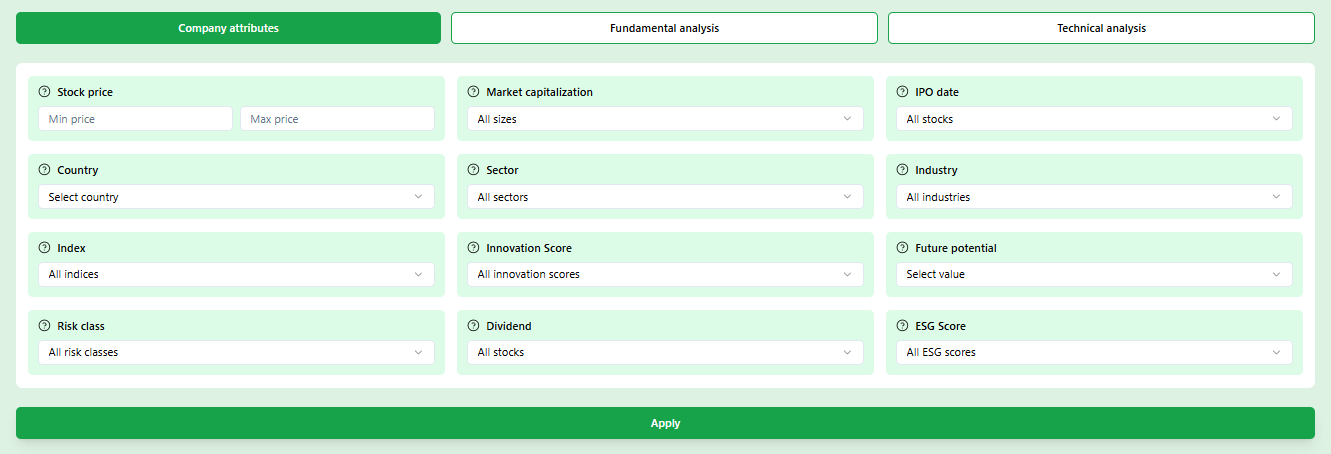
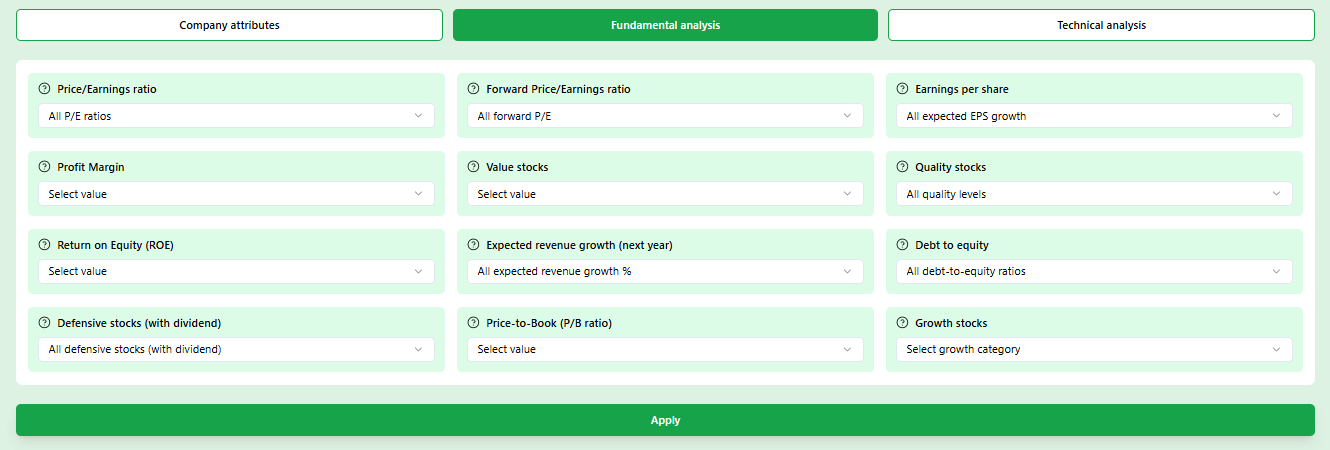
Generic screeners give you hundreds of parameters that mean nothing for a $0.80 stock. Belegget cuts through that. Set a price ceiling, a volume floor, and a market cap range. You immediately see which companies make it through.
Price filter below $1
Defines the true penny stock universe, not just anything cheap
Volume floor at 100k per day
Removes illiquid traps before they waste your research time
Market cap range
Target micro-cap or small-cap depending on your risk profile
How to find good penny stocks for beginners — the five-step approach
The most reliable way to find good penny stocks as a beginner is to follow a structured method. Each step builds on the previous one. Skip any of them and you are guessing, not investing.
Filter by price and volume first — not by potential
The first filter you set should be a share price ceiling below $1 and a daily volume floor. Volume is the most overlooked criterion when beginners try to find good penny stocks. A stock at $0.30 with 5,000 daily trades is dangerous: you could hold a position for months with no way to exit at a reasonable price. Start by eliminating every stock that does not meet a basic liquidity threshold. This alone removes around 70% of the universe and the worst traps along with it.
Read the revenue trend, not the price chart
Price charts for penny stocks are noisy and easy to manipulate. Revenue trends are much harder to fake. A company that has grown its revenue from $3M to $7M to $12M over three consecutive years is building momentum that eventually gets noticed by investors and analysts. Look at the year over year growth rate and the gross margin alongside it. High revenue growth paired with a margin below 20% may indicate a business that cannot scale profitably. This is a common pattern in commodity-driven penny stocks where price is set by the market, not the company.
Pick your sector and understand what drives it
Penny stocks are not evenly distributed. Technology and biotech dominate in terms of numbers, but each sector follows a very different logic. Biotech penny stocks often move based entirely on clinical trial results. Those are binary events that are nearly impossible for beginners to predict. Mining and energy penny stocks move with commodity prices, which are cyclical and easier to observe. For beginners, the most manageable starting point is small-cap tech companies that already have a product generating recurring revenue. Their performance is tied to sales execution rather than regulatory approvals or commodity cycles.
Small-cap tech
Mining / Energy
Check the balance sheet for dilution risk
Small companies frequently raise capital by issuing new shares. Every time they do, your existing stake gets diluted and the price typically drops. Before committing to any penny stock, check how many times it has issued new shares over the past three years. A company that has doubled its share count three times in three years is destroying shareholder value regardless of how good the business idea is. Look for a stable share count or, better yet, signs of buybacks. Also check cash: a company with 18 months of operating cash remaining has room to execute without diluting you immediately.
Use technical signals to time your entry, not to pick the stock
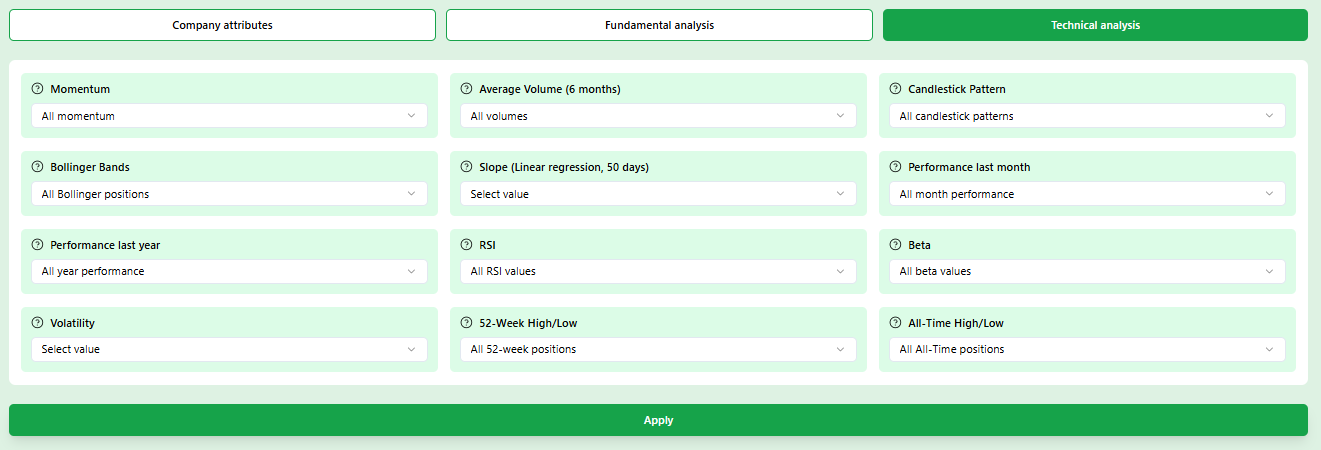
Technical analysis works differently for penny stocks than for blue-chip stocks. Patterns that hold reliably for liquid large-caps become noise in a stock that trades 50,000 shares a day. What technical analysis can do for penny stocks is help you avoid buying into a stock that has already spiked. It also helps you identify when a consolidating stock might be building for a move. RSI below 40 on a penny stock with solid fundamentals often signals that most sellers have already left. A stock near its 52-week low with improving volume can indicate accumulation by investors who have done the research. Belegget lets you filter on both, so you are not relying on chart reading alone.
Red flags every beginner should learn to spot
Knowing what to avoid is at least as important as knowing what to look for. These are the patterns that cause the most beginner losses.
Sudden price spike without news
A penny stock that doubles in one day without any company announcement is almost always a pump and dump. Someone bought large quantities first, promoted the stock online, and is now selling into your buy order.
Heavy promotion on social media
If you keep seeing the same ticker mentioned on forums and social channels, that is rarely organic. Penny stocks with genuine momentum tend to be discovered by investors doing fundamental research, not by viral campaigns.
Extremely low daily volume
A stock with 2,000 daily trades is not an investment. It is a locked door. You may be able to buy a position, but the moment you want to sell, you will find no one on the other side of the trade at a price you are willing to accept.
Repeated share issuances
Check the annual filings. A company that issues new shares every 12 to 18 months is telling you it cannot fund operations from its own cash flow. Each issuance dilutes existing shareholders and creates selling pressure the moment the new shares are released.
No audited financial statements
OTC Pink Sheet stocks are not required to file audited financials with the SEC. That means there is no independent verification of the numbers the company is reporting. Stick to NYSE- or Nasdaq-listed penny stocks where filing requirements are enforced.
How to reduce your exposure
Spread across five to ten positions so no single failure is catastrophic. Set a maximum loss per position (20 to 25% is a common starting rule) and stick to it. Use Belegget to pre-screen for volume and revenue before you even look at a chart.
Ready to find good penny stocks for beginners — right now?
Create a free account and apply the five-step approach directly inside Belegget. Volume filters, revenue data, balance sheet signals and sector selection. All in one place.
✓ No credit card · ✓ Instant access · ✓ Free basic filters included
Why beginners use Belegget for penny stocks
Designed to work for people who are serious about research but not professional analysts
Volume and price filters built in
Fundamentals on every stock page
Red flags highlighted automatically
Free to start, no commitment
Frequently Asked Questions About Finding Good Penny Stocks
Practical answers to the questions beginners ask most often about penny stocks
More guides to help you find the right stocks
Once you have the fundamentals down, these guides will sharpen your search further and expand what you can discover.
Best Small Cap Stock Screener
Move beyond penny stocks into the small-cap space. Discover which screeners handle this segment best and how to set them up effectively.
Penny Stock Screener
A focused look at the tools built specifically for filtering penny stocks. Compare features, data quality, and what separates them from general screeners.
Easy to Use Stock Screener
If you find most screeners overwhelming, this guide covers the platforms that get out of your way and let you focus on the stocks, not the software.