Guided from question to pick
No financial jargon walls
Matched to your risk level
Free to explore
Knowing which stocks deserve your attention can be difficult when there are thousands of companies to choose from. This guide explains the metrics investors commonly use, what information matters most, and how a stock screener can help you quickly focus on a smaller list of potential opportunities.
No financial background required. Written for beginners picking their first stock.
Answer a few questions and discover stocks that fit your preferences
The Smart Filter asks about your holding period, the type of company you want, and what growth phase you prefer. Based on your answers, it filters the full market and shows only the companies that genuinely fit you. For beginners picking a stock without knowing where to start, this is the fastest way to get to a real shortlist. No spreadsheets needed.
Holding period
Short term or long term changes everything about which stocks are suitable
Company type
Industry leader, emerging challenger or stable dividend payer
Growth phase
Early and fast growing, or mature and predictable
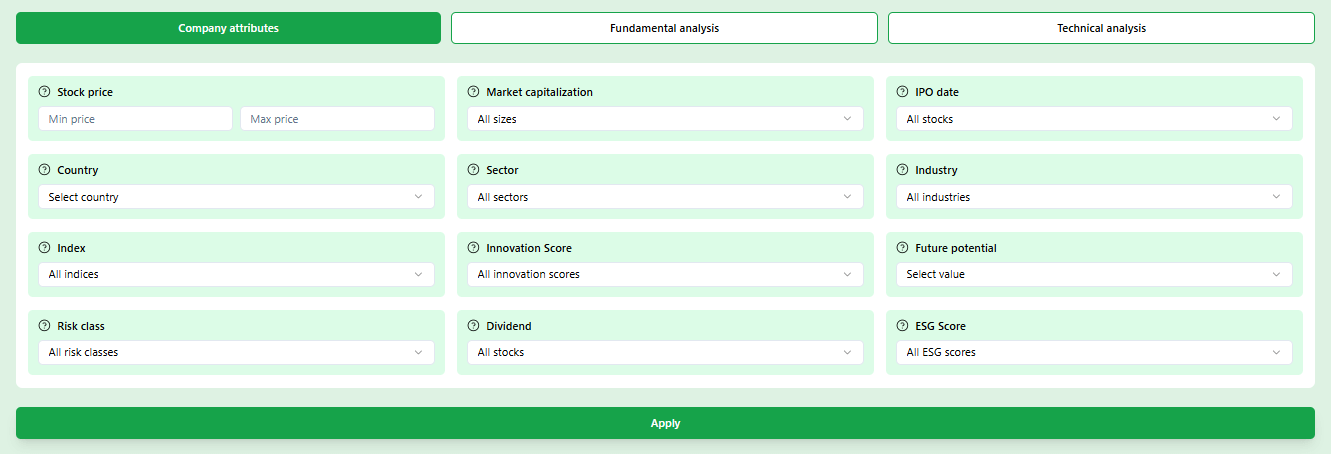
Set your own criteria and pick stocks that match your rules
Prefer the hands-on approach? Set filters manually. Choose a P/E range, a market cap bracket, a country, and a sector. The screener returns every company that clears all your criteria at once. Stock picking for beginners becomes a lot less guesswork when you define what you are looking for before you start browsing.
P/E ratio between 10 and 20
Filter for stocks priced at a reasonable multiple of earnings
Market cap between $2B and $10B
Mid-cap companies with room to grow and a track record behind them
Sector and country in one step
Narrow by region or industry without switching between tools
Growth stock or dividend stock: the first real choice when picking a stock
Most beginners pick a stock without consciously making this decision first, and that is usually where confusion starts. Neither type is universally better. It comes down to your timeline, your goal, and how comfortable you are with price swings.
Growth stocks
Companies that reinvest all profits into expansion. Revenue grows fast, but they rarely pay dividends. Price can rise significantly over 5 to 10 years, but short-term drops are common.
Dividend stocks
Established companies that pay a portion of profits to shareholders each quarter. Less price volatility, reliable income, and easier to understand for beginners starting out.
Blended approach
Many beginners find a mix of both useful. A stable dividend payer anchors the portfolio while a small allocation to growth stocks adds long-term upside without all-in exposure.
Timeline matters most
If you might need the money within three years, dividend stocks with lower volatility are generally safer. If you are investing for a decade or more, growth stocks become more appropriate.
Growth vs. Dividend at a glance
Five mistakes beginners make when picking stocks for the first time
These are not rare edge cases. They happen consistently and cost real money. Knowing them before you pick your first stock puts you ahead of most new investors.
Buying because everyone is talking about it
By the time a stock is trending on social media or in the news, the easy gains are usually already priced in. Buying on hype is not a strategy.
Selling during a temporary dip
Short-term drops of 10 to 20 percent are normal for almost every stock. Selling in a panic locks in losses and means you miss the recovery.
Putting everything into one company
Even very strong companies can drop sharply due to factors outside their control. Spreading across 8 to 15 stocks dramatically reduces that risk.
Ignoring the valuation
A great company at the wrong price is still a bad investment. A stock trading at 80 times earnings already has a lot of optimism baked in and little room for disappointment.
Checking the price multiple times per day
This leads to emotional decisions. Set a schedule for reviewing your portfolio, maybe once a week, and stick to it rather than reacting to every daily movement.
How to sidestep all of them
Use a screener to select companies based on data rather than news. Set your criteria in advance. Review on a schedule. Let the filter do the filtering.
Why Belegget helps beginners pick stocks with more confidence
Designed around the questions beginners actually ask when picking a stock, not the ones analysts do
Ready to find your first stocks?
Create a free account and use the screener today. No credit card required.
What experienced investors know about picking stocks that beginners often skip
These are the practical concepts that separate investors who pick stocks consistently well from those who rely on gut feeling
Reading a P/E ratio correctly takes 30 seconds
The price-to-earnings ratio divides the stock price by the annual earnings per share. A ratio of 15 means you are paying $15 for every $1 of annual profit the company generates. Whether that is cheap or expensive depends entirely on the sector and the company's growth rate. A bank at a P/E of 15 might be fairly priced. A software company at a P/E of 15 might be very cheap if it is growing at 30 percent per year. When picking a stock as a beginner, this single number already tells you a lot about what the market currently expects.
The most common mistake here is comparing P/E ratios across sectors. A utility company will almost always have a lower P/E than a tech company, not because it is cheaper, but because its growth prospects are different. Always benchmark within the same industry, and ask yourself why the ratio sits where it does.
Sector diversification is not the same as portfolio diversification
Owning ten technology stocks does not give you a diversified portfolio. When the tech sector drops, all ten will likely drop together because they share the same underlying market forces: interest rate sensitivity, consumer sentiment, and regulatory risk.
True diversification means spreading across sectors that do not move in lockstep. Healthcare, consumer staples, financials, and energy often behave differently from technology. Adding companies from different regions adds another layer. The goal is not to own many stocks, it is to own stocks whose fortunes are not all tied to the same conditions.
Why the 52-week range tells you more than the current price
A stock trading at $48 means nothing without context. If that stock was at $90 twelve months ago, you are looking at a company that has lost nearly half its value. If it was at $30 a year ago, it has gained significantly. The 52-week range shows you the full picture of recent performance and puts the current price in perspective. For beginners picking a stock, this context is often more useful than the price alone.
A stock near its 52-week low is not automatically a bargain. There is usually a reason for the decline. But combined with solid fundamentals and no structural problems in the business, a company trading well below its high can represent a genuine opportunity for patient investors willing to do the research first.
Free cash flow: the number analysts look at before almost anything else
Earnings per share gets a lot of attention, but free cash flow is the number that shows what a company actually has left after running the business and maintaining its assets. You cannot pay dividends, buy back shares, or invest in new products with accounting profits. You can only do those things with real cash.
A company with strong free cash flow growth has options. It can reward shareholders, reduce debt, or expand. A company with declining free cash flow despite strong reported earnings should prompt questions, not automatic confidence. Beginners who learn to check this number early will avoid a category of traps that catches many experienced investors.
Building a watchlist before buying is worth more than you think
The stocks that seem most attractive often look different after you have watched them for four to six weeks. Sometimes the initial enthusiasm fades when you check back on the fundamentals and realize the growth story was already priced in. Sometimes conviction grows because the company keeps performing exactly as you expected. Either way, you pick a stock from a much stronger position than on day one.
A watchlist forces discipline. You commit to monitoring without committing capital. You see how the stock reacts to earnings reports, sector news, and broader market moves. By the time you decide to invest, you have real context rather than a first impression. This step is often skipped by beginners picking stocks too quickly, and it shows in their results. Most serious investors maintain a watchlist three to five times larger than their actual portfolio.
What Belegget gives you to work with
Five tools built for investors who are still learning what to look for
Fundamental filters without the noise
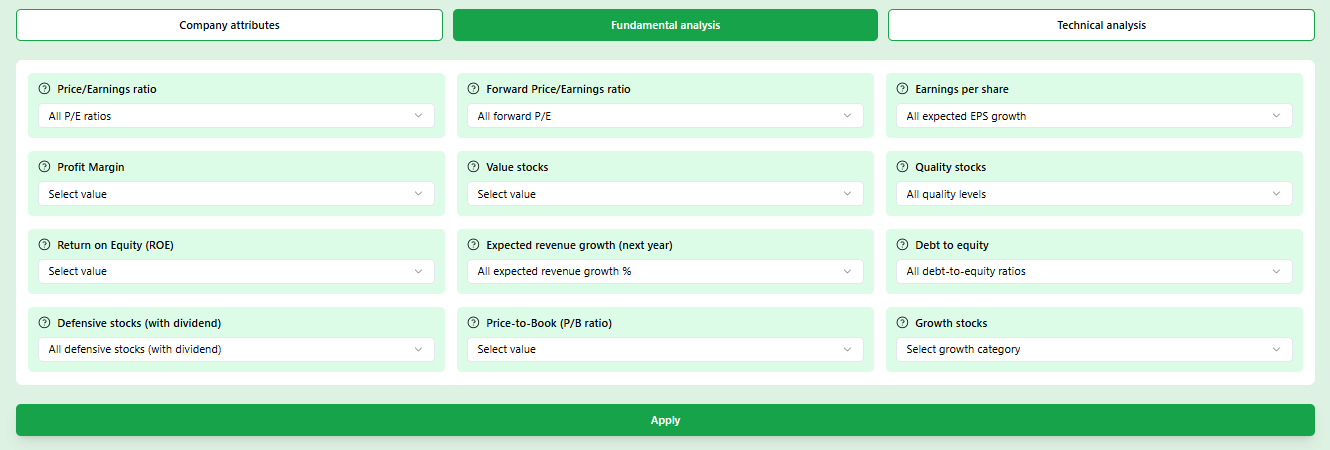
Choose your P/E range, dividend yield threshold, debt level, and market cap. The screener returns only companies that clear every hurdle simultaneously. You do not need to know 50 metrics. Start with three or four and expand as you learn.
Company data on a single page
Revenue growth, profit margins, debt-to-equity, and dividend history all on one screen for each company you click on. You do not need to hunt across annual reports and investor presentations to get a basic picture of the business.
Watchlist to track before committing
Save companies you find interesting and revisit them over several weeks. Watching a stock through an earnings report or a sector dip before buying it gives you far more useful data than making an immediate decision based on a single screen.
Performance and momentum at a glance
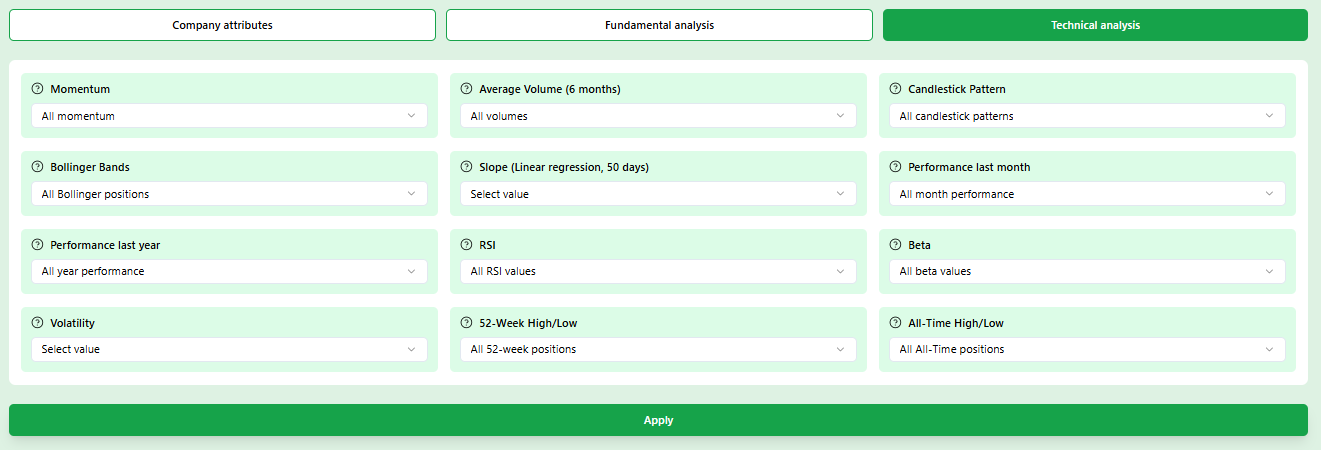
See how a stock has performed over the past month, three months, six months, and full year. Momentum filters let you find companies in an uptrend or identify those that have pulled back significantly from recent highs.
Smart questionnaire for a guided start
Not sure which filters to set? Answer the guided questions instead. The screener translates your preferences into a tailored filter combination and shows you a results list. It works well for people who know what they want but are not yet sure which metrics to use.
Questions beginners actually ask
Practical answers to the questions that come up most when you are starting out
Start picking stocks that actually match your goals as a beginner
Create a free account and use the screener today. See which stocks come up for your profile before you commit to anything.
More stock screener guides worth reading
Once you know how to pick a stock, these guides help you find companies in specific categories that match popular investment strategies.
Dividend Stock Screener
Find companies with consistent dividend histories, healthy payout ratios, and the financial strength to keep paying shareholders for years to come.
Undervalued Stock Screener
Identify stocks trading below their intrinsic value using P/E, price-to-book, and free cash flow metrics. A starting point for value-conscious investors.
Value Stock Screener
Screen for established companies with strong fundamentals, low debt, and attractive valuations relative to their sector peers and historical averages.