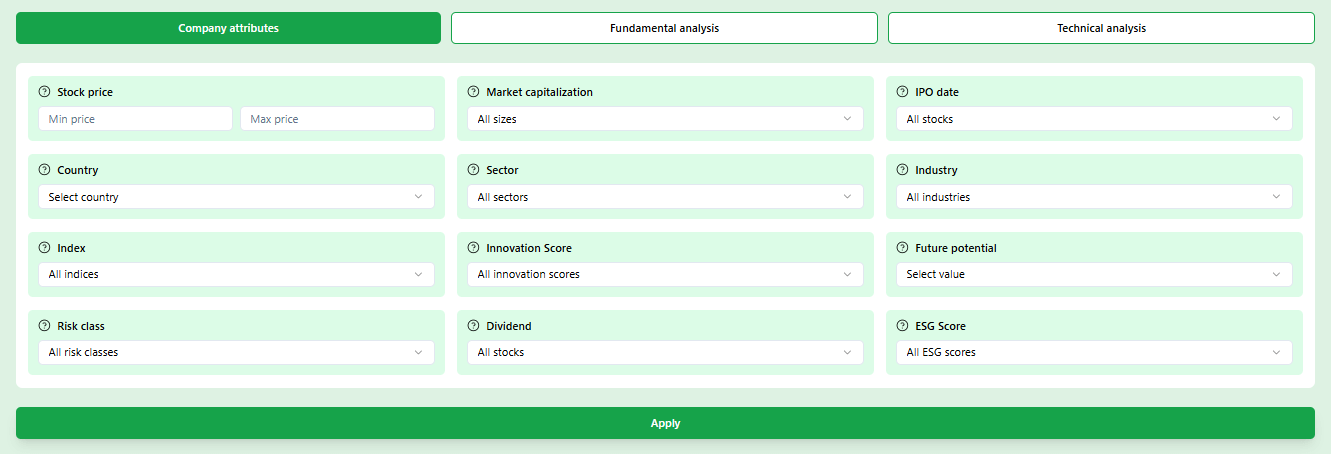
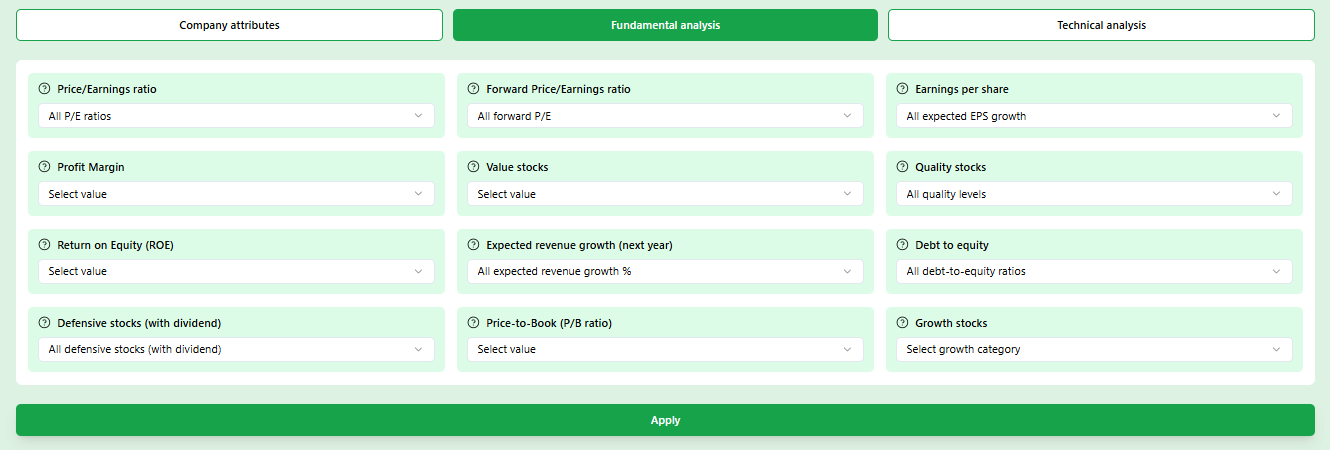
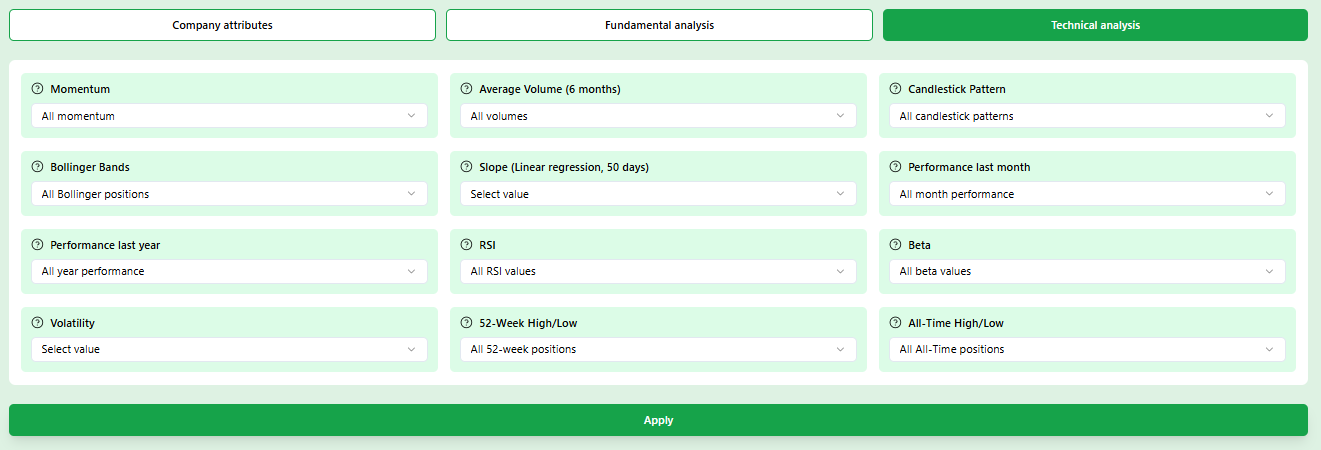
Finding penny stocks is easy. Finding penny stocks that deserve closer research is more challenging. A good penny stock screener helps you go beyond share price by combining filters such as trading volume, market capitalization, sector, country, and fundamental metrics to create a more focused shortlist.
✓ No credit card required · ✓ Instant access · ✓ Free filters included
Set your filters and find penny stocks now
Start with price below $1 and market cap in the micro-cap range. Add sector and volume to narrow down to the stocks that are actually tradeable.
Three filters that immediately remove the worst penny stocks
Most penny stock investors lose money on illiquid positions they cannot exit. The penny stock screener in Belegget starts with the three filters that protect you from that problem before anything else on the list.
Share price ceiling (max $1.00)
Defines the universe. Change it to $5 or any value that fits your own definition of low-priced.
Volume floor (min 100,000 shares per day)
Removes stocks you cannot exit without moving the price against yourself.
Market cap range (micro cap to small cap)
Keeps you in a size bracket where real upside still exists but institutional interest provides some floor.
What a penny stock screener actually needs to do
Price alone is not enough. These are the six filter categories that make the difference between a useful penny stock shortlist and a list of stocks you should never have looked at.
Volume: the liquidity gate
A penny stock with fewer than 50,000 shares traded per day is effectively a position you cannot exit in a hurry. The volume filter removes illiquid traps before anything else. Setting a floor of at least 100,000 daily shares is the single most protective step in any penny stock screener workflow.
Price ceiling: defining the universe
Not all low-priced stocks are penny stocks and not all penny stocks are equally risky. Setting an exact price ceiling rather than a predefined category lets you choose between the classic sub-$1 definition and the broader sub-$5 universe where liquidity is meaningfully better.
Market cap: size determines stability
Micro-cap penny stocks ($50M to $300M) behave very differently from nano caps below $50M. The market cap filter keeps your results in a size bracket where price discovery is more transparent and a single sell order does not move the stock 10% against you.
Cash runway: dilution prevention
A company with three months of cash left will issue new shares to survive. That action dilutes your stake and almost always pushes the price lower. Filtering for companies with at least 12 months of operating cash eliminates a large proportion of high-risk candidates at once.
Sector and country: context over guesswork
A US technology penny stock and a Canadian mining penny stock are completely different research exercises. The sector filter separates them. The country filter lets you stay in markets you understand. Combining both narrows your screener results to a set where you can actually evaluate what you find.
Technical signals: timing the entry
After the fundamental filters have built your shortlist, RSI and 52-week position help you decide which stocks to act on first. An RSI below 40 on a fundamentally solid penny stock often signals that selling pressure is exhausting itself, which is a far more useful entry signal than buying something that has already spiked.
The five filter categories every penny stock screener should cover
Using a penny stock screener effectively means knowing which filters to use and in what order. Each category below solves a different problem in the penny stock research process.
Price filter: defining your penny stock universe
The price ceiling in a penny stock screener is not just a starting point. It is a choice about which market you want to participate in. Stocks under $1 are the strictest penny stock definition and carry the highest risk because they often lack institutional coverage. Stocks under $5 include a broader range of companies, some of which have real analyst followings and significantly better liquidity. Choosing your price ceiling thoughtfully is the first decision in any serious penny stock screener workflow. Belegget lets you set any value you want, down to cent-level precision, which means you can search for stocks under $0.50 or under $2.00 without being forced into fixed tiers.
Volume and market cap: the liquidity checkpoint
Volume and market capitalization together tell you how tradeable a penny stock actually is. A stock with 200,000 daily shares traded and a $150M market cap is far safer to enter and exit than one with 8,000 daily shares and a $20M cap, even if both are priced at $0.70. In a penny stock screener, setting a volume floor of at least 100,000 shares per day removes most illiquid trap stocks from your results in one step. The market cap filter adds a second layer: stocks below $50M in market cap are almost always extremely risky, because even a small sell order can move the price significantly. Keeping your market cap range between $50M and $500M gives you a realistic set of candidates where price discovery is more transparent and your position size matters less.
Sector and country filters: narrowing to what you understand
Penny stocks are not evenly distributed across all sectors and markets. In the United States, technology and biotech dominate the sub-$1 price range. In Canada and Australia, mining and resource companies make up the largest share of penny stock activity. In Europe, a broader mix of industrials and financial sector companies appear at low price levels. Understanding these patterns helps you use the sector and country filters in a penny stock screener more effectively. If you are researching US biotech penny stocks, outcomes are largely driven by clinical trial data, which is binary and difficult to predict. US technology penny stocks with existing revenue are easier to research because you can evaluate product traction and customer growth directly. Belegget lets you combine sector and country filters simultaneously, so you can run a search like "technology sector, US listed, revenue growing, price under $1" in a single filter set.
US Technology
Canadian Mining
US Biotech
European Industrials
Fundamental filters: revenue, cash runway and dilution signals
A penny stock screener that only filters by price will send you toward the worst companies in the market. The fundamental layer in Belegget adds three critical checks that most price-only screeners miss entirely. First, revenue trend: a company with growing revenue is building something real; a company with declining revenue at a low price is often in trouble, not undervalued. Second, cash runway: small companies burn cash, and a runway of less than six months almost certainly means new shares are coming, which dilutes your position. Third, the share count history: a company that has doubled its outstanding shares three times in three years is destroying shareholder value regardless of whether the business idea is interesting. The Belegget fundamental filter set covers all three in a single filter panel, letting you add them on top of your price and volume settings without switching screens.
Technical filters: timing your entry after the research is done
Technical filters in a penny stock screener serve one specific purpose: they help you avoid buying into a stock that has already spiked and is likely to pull back. After you have used the price, volume, fundamental and sector filters to build a list of viable candidates, the technical layer helps you choose which ones to act on first. RSI below 40 on a penny stock with solid fundamentals suggests that sellers have exhausted themselves without a fundamental reason for the drop. A stock trading 35% below its 52-week high with increasing volume over the past 30 days is showing early signs of accumulation. Neither signal is a guarantee, but combining them with the research you have already done through the other filters gives you a structured entry process rather than a guess. The Belegget screener includes RSI, 52-week distance, 3-month momentum and recent volume trend in the same interface as all other filters.
Not sure which filters to set? Let the Smart Filter guide you
The Smart Filter in Belegget replaces manual filter setup with three short questions about your penny stock preferences. Based on your answers, it builds the complete filter set for you and shows you a curated shortlist immediately.
Price ceiling preference
Under $1, under $5 or a custom value. The screener adjusts the universe to match.
Sector and stability
Whether you want established revenue or are comfortable with pre-revenue growth companies.
Risk tolerance
Micro cap or small cap, aggressive or conservative. The filter combination changes based on your answer.
Start using the penny stock screener today
Set your price ceiling, add a volume floor, pick your sector and see which penny stocks actually qualify. Free to start, no credit card needed.
✓ No credit card · ✓ Instant access · ✓ Free filters included
Why investors use Belegget as their penny stock screener
Built for people who want to research properly rather than guess on tips
Price and volume filters first
Fundamental data on every result
Global market coverage
Free tier with real filters
Frequently Asked Questions About the Penny Stock Screener
Practical answers to the most common questions about using a penny stock screener
More guides to sharpen your stock research
Once you have the penny stock screener set up, these guides will help you expand your research into adjacent opportunities.
Best Small Cap Stock Screener
Move beyond penny stocks into the small-cap universe. Covers which screeners handle the $300M to $2B range best and how to set the right criteria.
Growth Stock Screener
When a penny stock grows into a mid-cap, growth metrics become the primary driver. Learn which filters separate genuine growth from inflated expectations.
How to Find Good Penny Stocks for Beginners
The screener is only half the process. This guide explains the five-step method for evaluating each result you get from a penny stock screener.