Institutional criteria
25,000+ global stocks
Built-in strategy logic
One platform, all tools
Hedge funds and professional investors do not pick stocks randomly. They filter on return on equity, free cash flow and debt levels before they even open an annual report. This smart money stock screener gives you access to those same criteria so you can build a shortlist of quality stocks in minutes rather than hours.
✓ Immediate access · ✓ No credit card needed
What does smart money investing actually mean?
Smart money is a term for the capital managed by institutional investors: pension funds, hedge funds, asset managers and large family offices. These players move markets. When a quality company hits a rough patch and retail investors panic-sell, smart money often steps in because they have done the work. They are not buying on a tip or a tweet. They are buying because the fundamentals hold up.
The good news is that their criteria are not secret. They are looking for businesses that generate high returns on the capital they deploy, keep debt manageable, and produce more cash than they spend. You do not need a Bloomberg terminal to find those companies. You need a screener that lets you set the right thresholds and then shows you what passes the test.
Retail investors
Smart money investors
Answer a few questions and get your smart money shortlist
Most investors know what kind of company they want, but translating that into screener criteria takes time. The Smart Filter does the translation for you. Three questions about your investment horizon, risk tolerance and company type are enough to produce a list of candidates that already pass the smart money bar.
Investment horizon
Short, medium or long term shapes which metrics matter most
Risk tolerance
Conservative, balanced or growth-oriented filters adapt accordingly
Company type
Quality compounders, turnarounds or dividend payers each need different screens
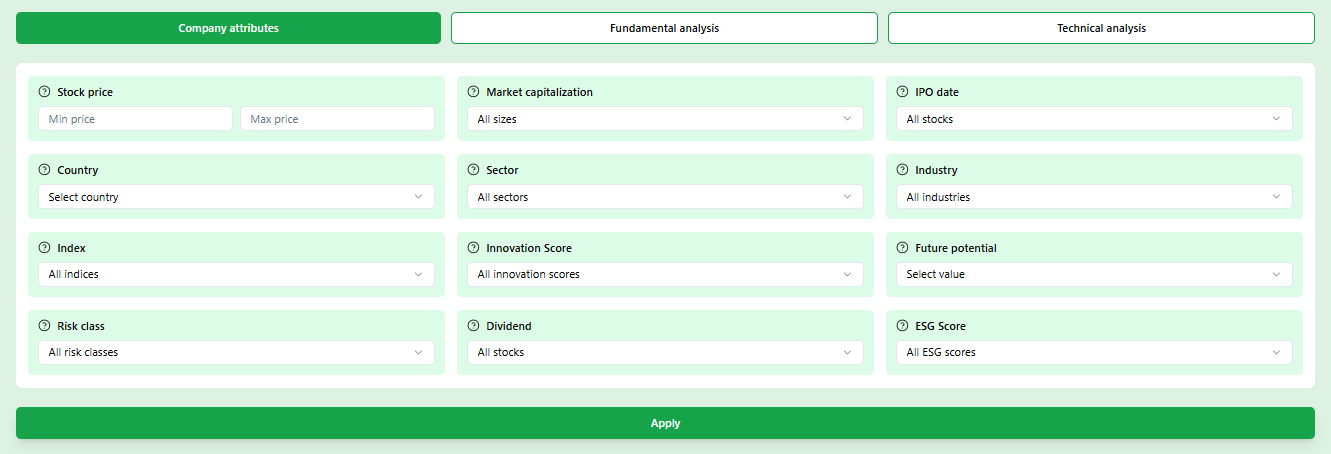
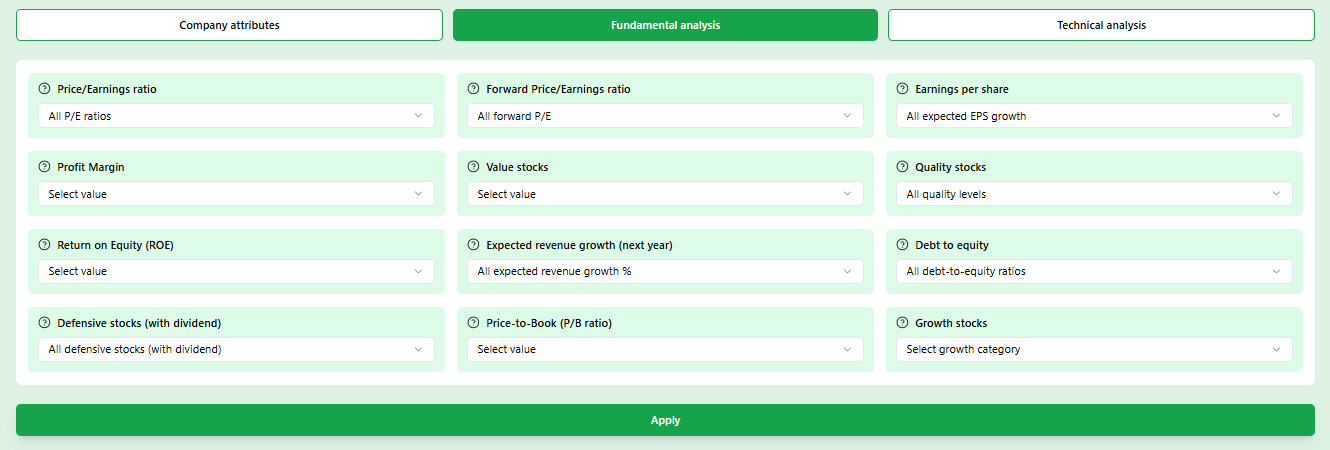
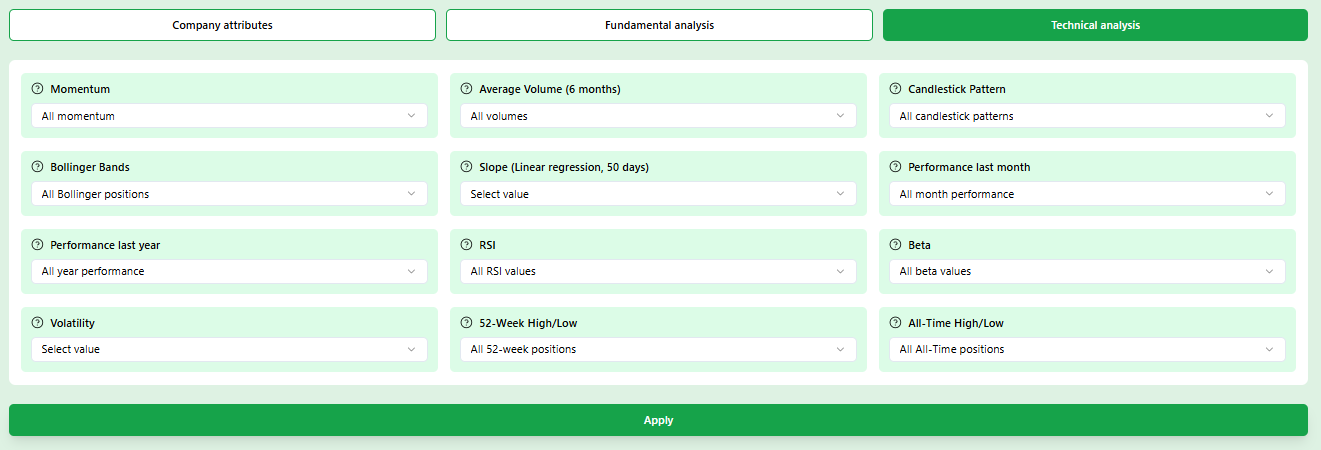
Set your own institutional-grade filters
Prefer to go manual? The advanced filter view gives you full control. Set thresholds for ROE, ROIC, debt levels, cash flow yield and dozens of other metrics and see the results update in real time across our entire stock database.
36 quality filters
From basic P/E to advanced ROIC and cash conversion cycle
Real-time results
The stock list updates instantly as you adjust any threshold
Save and revisit
Store your filter setup and rerun it whenever you want a fresh scan
Start using the smart money stock screener today
Create a free account and run your first quality screen in under five minutes. No credit card required.
✓ No credit card required ✓ Instant access ✓ Free basic features
The five metrics that define a smart money stock
Every filter in the screener serves a purpose. Here is what each metric tells you and why professional investors treat it as a minimum requirement before considering a position.
Return on Equity tells you how efficiently management runs the business
Return on Equity (ROE) divides net profit by shareholder equity. A company with 20% ROE generates 20 cents of profit for every euro shareholders have put in. That sounds simple, but it is one of the most revealing numbers in finance. Buffett has publicly said he looks for businesses with ROE consistently above 15% because it tells him management knows how to allocate capital rather than just accumulating it.
The smart money stock screener lets you set a minimum ROE threshold and instantly see which companies clear the bar across your chosen region or sector. A high ROE sustained over five or more years is far more meaningful than a single strong year that followed a one-off gain.
ROIC and free cash flow separate real quality from accounting noise
Return on Invested Capital (ROIC) goes one step further than ROE. It measures what the company earns on all the capital it uses, including debt, not just equity. A business with a high ROIC relative to its cost of capital is genuinely creating value rather than just reporting it. Hedge fund managers use ROIC as a primary filter for this reason.
Free cash flow yield ties it together by showing what the business actually puts in the bank after all capital spending. Companies can report strong profits but weak free cash flow because of accounting choices. When both ROIC and free cash flow yield are solid, the quality signal becomes much harder to fake. The screener lets you filter on both at once.
Debt levels determine how much risk sits under the surface
A company growing quickly with a lot of debt attached is not the same as one growing organically from its own cash generation. Smart money distinguishes between the two. When interest rates rise or revenues dip, a heavily indebted business faces pressure that a clean balance sheet company simply does not. That is why debt-to-equity ratios and interest coverage appear on almost every institutional screening checklist.
In the smart money stock screener you can filter on debt-to-equity, net debt to EBITDA and interest coverage simultaneously. Setting a cap on leverage immediately removes a large category of companies that look attractive on headline earnings but carry meaningful downside risk when conditions change.
Sector and regional filters put smart money criteria in context
A 20% ROE in software is common. In banking it means something entirely different. Context matters when reading financial ratios, and that is why sector-specific filtering is part of how institutional investors approach screening. They compare companies within their peer group rather than across all industries simultaneously.
The screener covers 52 countries and all major GICS sectors. You can combine a regional focus with sector filters and then layer your quality metrics on top. This is how you find a high-ROE industrials company in Europe or a low-debt technology business in Asia without having to manually sort through thousands of names.
Save your best finds and track them with a watchlist
Finding a quality stock is one thing. Buying at the right moment is another. Most professional investors build a watchlist of companies they would own at a certain price and wait for the opportunity. This is sometimes called a buy-below list and it is a practical way to avoid chasing overvalued stocks while staying ready to act when valuations become attractive.
With Belegget you can save any stock from your screener results to a personal watchlist, set price alerts and receive notifications when the company reaches your target entry zone. You can maintain separate lists for different strategies such as dividend income, quality growth or deep value and switch between them at any time.
Why investors use Belegget as their smart money screener
Built around the criteria that matter to long-term, quality-focused investors
How smart money investors actually build a position
The process behind institutional stock selection is more structured than most retail investors realize. Here is the four-step approach that separates disciplined investors from impulsive ones.
Define the quality threshold
Before looking at any individual stock, smart money sets minimum standards. ROE above 15%, net debt below 2x EBITDA, and positive free cash flow in at least four of the past five years. These thresholds filter out the majority of the market immediately, leaving a manageable pool to work from.
Screen for durable competitive advantages
A high ROE this year means little if a competitor can replicate the business model next year. Smart money looks for moats: pricing power, switching costs, network effects or scale advantages that protect margins over time. The screener narrows the list further by filtering on consistent gross and operating margins over five-plus years.
Check the valuation against intrinsic value
Even the best business is a poor investment if you overpay. After screening on quality, institutional investors compare the current price to their estimate of intrinsic value using metrics like EV/EBIT, price-to-free-cash-flow and the earnings yield relative to bond yields. The screener surfaces all of these values so you can make a direct comparison.
Build the position over time
Smart money rarely buys a full position on day one. They set a target price or valuation range and build gradually, often using price dips as opportunities to add at better levels. A watchlist with price alerts, exactly what Belegget offers, is the practical tool for executing this approach without watching screens all day.
What the world's best investors actually screen for
Their public letters and interviews reveal specific criteria. These are the thresholds that have informed how the Belegget smart money stock screener was built.
Questions about the smart money stock screener
Answers to the most common questions from investors who are new to quality screening
More stock screeners worth exploring
Different strategies call for different filters. These guides cover three of the most popular screener types for investors who want to go beyond smart money quality screens.
Growth Stock Screener
Find companies growing revenue and earnings faster than the market expects, before the consensus catches up.
Dividend Stock Screener
Screen for reliable dividend payers with strong payout histories, healthy coverage ratios and room to grow distributions.
Penny Stock Screener
Discover small and micro-cap stocks trading at low prices with the filters that matter most for high-risk, high-reward opportunities.