P/E and P/B ratio in context
Quality filters that separate value from traps
Free cash flow as the honest number
25,000 stocks across 52 countries
The value stock screener filters 25,000 companies by P/E ratio, price to book, return on equity, free cash flow and debt levels. Set your criteria and find stocks trading below what their fundamentals actually justify.
Try the value stock screener right now
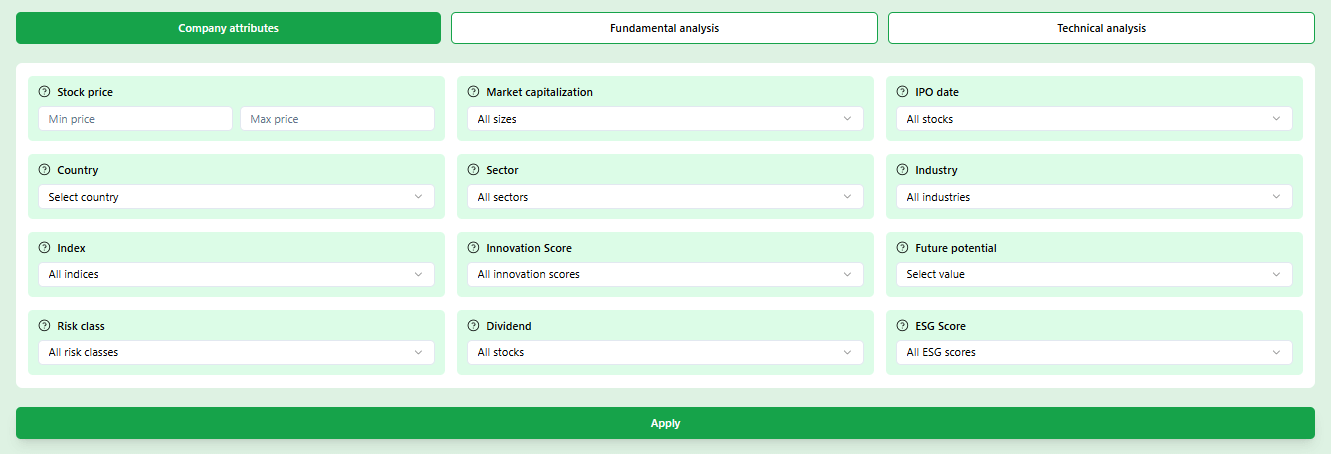
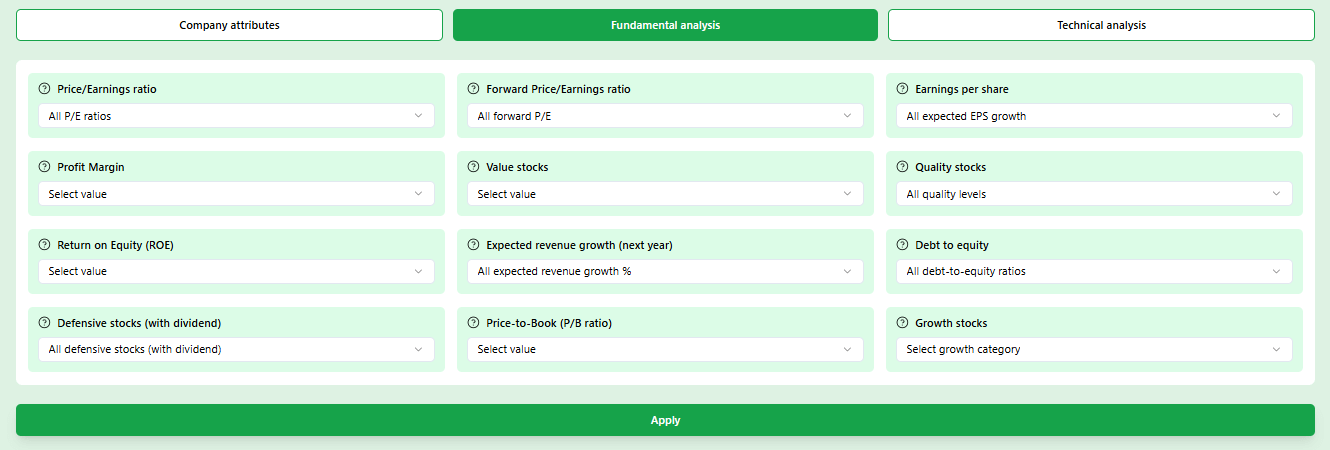
All value filters visible at once. Combine P/E ratio, price to book, return on equity and debt levels to build your shortlist.
Answer a few questions and the value stock screener builds your shortlist
Tell the Smart Filter what type of company you want, how important income is and what your holding period looks like. It translates your answers into the right combination of value filters and shows you the companies that actually fit.
Company type and quality level
Established value, dividend payer or turnaround situation — you define it
Income vs capital appreciation
Filter on dividend yield and free cash flow simultaneously
Holding period and risk tolerance
Deep value with patience or moderate undervaluation with near-term catalyst
Filters built specifically for value stock analysis
P/E ratio, price to book, return on equity and debt coverage in one place. No switching between data sources to piece the picture together.
P/E and forward P/E ratio
Trailing and forward earnings multiples filtered by sector to give context
Price to book with quality gate
Book value discount combined with return on equity to separate value from traps
Debt to equity and coverage
Balance sheet strength as a risk filter before you evaluate the valuation
Four things that make this value stock screener different
Built around the metrics that separate genuinely undervalued businesses from companies that are cheap for a reason
How to use a value stock screener the way professional investors actually do
Each filter measures something specific. Understanding what it measures and when it matters is what turns a screener from a list generator into a genuine research tool
Ready to find your next value stock?
Start with a free account and run your first value screen today. 25,000 stocks, 52 countries, no credit card required.
Frequently asked questions about the value stock screener
Answers to the questions most value investors ask before they start screening
About Belegget
Belegget was built on a simple observation: most stock screeners are either too basic to be useful or so complex that only professional analysts can get value from them. The value stock screener sits in the middle: the filters that actually matter for value investing, presented in a way that makes sense without a finance degree.
More screeners to sharpen your stock analysis
Value investing is one lens. These guides cover complementary screeners and tools that help you build a more complete picture before you commit capital.
Undervalued Stock Screener
Find stocks trading below their calculated intrinsic value using enterprise value, earnings yield and quality score in combination.
Intrinsic Value Stock Screener
Screen specifically for the gap between current price and intrinsic value estimates to identify the deepest discounts in the market.
Best Stock Picking Tools
An overview of the most effective tools for independent investors, from screeners to portfolio trackers and fundamental analysis platforms.
Frequently Asked Questions
- What is a value stock screener and how does it differ from a general screener?
- A value stock screener is built specifically around the metrics that identify companies trading below what their fundamentals justify. Where a general screener might show you everything from growth metrics to technical indicators simultaneously, a value stock screener prioritises P/E ratio, price to book, free cash flow yield, return on equity and debt levels. The filters are calibrated for the reality that value investing is about paying less than a business is worth, not just finding the cheapest stocks. This screener helps you evaluate whether a low valuation reflects genuine opportunity or a business in structural decline.
- What P/E ratio should I filter for when looking for value stocks?
- This depends heavily on the sector and the interest rate environment. In consumer staples and utilities, a P/E below 15 historically represents fair to good value. In financial companies, P/E is less useful than price to book because earnings can be volatile. In technology, even value-oriented investors often accept higher multiples because the capital requirements are lower and the profit margins much higher. The value stock screener lets you combine P/E with return on equity and sector filters precisely because there is no single P/E threshold that makes sense across all industries.
- What is the difference between value investing and buying cheap stocks?
- Value investing means buying businesses at prices below their intrinsic worth. Buying cheap stocks means buying whatever has the lowest price or multiple regardless of quality. The difference matters enormously in practice. A stock trading at 6 times earnings because the business is losing customers, carrying excessive debt and watching margins deteriorate is not a value investment. It is a value trap. A stock trading at 14 times earnings because the market has temporarily overreacted to a cyclical setback in an otherwise excellent business is a genuine value opportunity. The screener helps you make that distinction by combining valuation with quality metrics.
- How useful is the price to book ratio for finding value stocks today?
- Price to book is most useful for asset-heavy businesses: banks, insurance companies, industrial manufacturers, real estate and energy companies. For software and consumer brands, book value understates intrinsic value dramatically because most of the value sits in intangibles like brand equity and intellectual property that do not appear on the balance sheet. Benjamin Graham
- Can the value stock screener help me avoid value traps?
- Yes, specifically by combining low valuation filters with quality filters. A value trap is a stock that looks cheap on P/E or P/B but deserves to trade at a discount because the business is deteriorating. The most reliable way to avoid them is to require high return on equity, positive free cash flow, manageable debt and at least stable earnings trend alongside the low valuation. When all four are present, the probability of a genuine value opportunity is significantly higher than when you rely on P/E or P/B alone.
- What is the role of debt when screening for value stocks?
- Debt amplifies risk in ways that valuation multiples do not capture. A company trading at 8 times earnings but carrying six times its annual earnings in net debt is not cheap once you account for the full cost of that leverage. Enterprise value to EBITDA is a more honest way to compare companies with different capital structures because it adds debt to the market cap before dividing by earnings. The value stock screener includes debt to equity and EV/EBITDA filters precisely so you can identify businesses that are genuinely cheap on a fully loaded basis rather than appearing cheap because their balance sheet risk is not reflected in the share price.
- Should I focus on dividend-paying value stocks?
- Dividends can be useful signals when screening for value, but they are not inherently part of value investing. A company paying a 4 percent dividend yield while compounding free cash flow at a high rate may be the best investment. The same company paying 4 percent while its business deteriorates is destroying value per share over time. The screener lets you filter on dividend yield while also checking free cash flow coverage, which tells you whether the dividend is sustainable. Dividends paid out of genuine free cash flow surplus are very different from dividends maintained for optics while the business generates less cash than it distributes.
- How often should I run the value stock screener?
- Value opportunities tend to emerge during market corrections, sector rotations and periods of general pessimism rather than continuously. Many value-oriented investors run their screener monthly as a baseline and then run additional targeted screens when a sector has sold off significantly, when interest rates have moved sharply or after quarterly earnings seasons when stocks often overreact to single quarter results. The most productive use is to have a saved filter combination ready so you can run it quickly when conditions create the dislocations that value investing depends on.
- Can I screen for value stocks outside the United States?
- Yes. The screener covers stocks across 52 countries. Some of the most compelling value opportunities at any point in time are in markets that receive less attention from English-language financial media. European industrial companies, Japanese conglomerates trading below net cash, Korean manufacturers and Taiwanese technology companies have all cycled through periods of extreme cheapness relative to their underlying quality. The country and region filters let you explore these markets specifically or run the full fundamental filter combination globally to find where cheapness and quality overlap regardless of geography.
- Can I try the value stock screener for free?
- Yes. The core value filter set including P/E ratio, price to book, sector, country, market cap, return on equity, debt to equity and the 52-week position filter is available on a free account. Premium filters like the Value Score composite, quality score, free cash flow yield and the Smart Filter questionnaire require a subscription. Many investors find the combination of P/E, ROE and debt filters in the free tier already produces a focused list of genuine value candidates before deciding whether the additional premium tools add enough depth.