Guided filtering, not raw data dumps
Reliable, up-to-date data
Works well on mobile
Explains what the numbers mean
When searching for the best apps for beginner investors, you'll quickly notice that most platforms are built for people who already know what they're doing. This guide breaks down what actually separates a useful app from a confusing one, and shows how a guided stock screener works in practice.
✓ Free account · ✓ No credit card needed · ✓ Android and iOS
What the best apps for beginner investors have in common
Not all investing apps are built the same. Here's what actually matters when you're starting out and don't have years of experience to fall back on.
Why data reliability matters more than most people think
One thing beginners often overlook is where the numbers actually come from. Some apps aggregate data from free public sources with limited coverage, leading to missing values or figures that are weeks out of date. Belegget uses data from EODHD, a professional financial data provider with coverage across thousands of listed companies globally. The fundamentals, ratios, and price data are refreshed daily. When you're making decisions about where to put your money, knowing that the numbers you're looking at are current and from a verifiable source makes a real difference.
How to actually compare the best apps for beginner investors
Before you download anything, here's a concrete framework for evaluating which beginner investing apps are worth your time. Use this as your personal checklist.
Checklist: what to check before you commit
A P/E of 18 tells you nothing if you don't know what a P/E is. The app should explain it in context, not just display it.
The best apps for beginner investors let you describe your goal (e.g. 'stable dividend payer') and do the filtering for you.
Check whether the app mentions its data source and how often it's updated. Unattributed data is a red flag.
Most people research stocks on mobile. If the app doesn't work properly on a small screen, it's not really built for modern use.
A watchlist or favorites function is essential. Otherwise every session starts from scratch.
You should be able to evaluate the core experience before paying anything. Be cautious of apps that require a subscription upfront.
⚠ Red flags to avoid
How Belegget scores on this checklist
Belegget was built with exactly these criteria in mind. The guided questionnaire handles filtering without requiring financial knowledge, data is sourced from EODHD and updated daily, and the app runs natively on both Android and iOS. You can start for free and build your watchlist from day one.
If you use the checklist above to evaluate the best apps for beginner investors currently on the market, Belegget checks every box — without making you feel like you need a finance degree to use it.
Answer a few questions and get a matched stock list
The smart questionnaire in Belegget asks about your investment horizon, the type of company you're looking for, and the growth phase you're comfortable with. Based on your answers it assembles a list of stocks that fit your profile. No setup required, no finance knowledge assumed.
No technical background needed
Every question is written in plain language with clear options to choose from
Dynamic and adaptive
Questions adjust based on what you've already answered, keeping the process relevant
Results in minutes
You go from zero to a personal stock list faster than reading a single investment article
Set your own filters when you're ready for more control
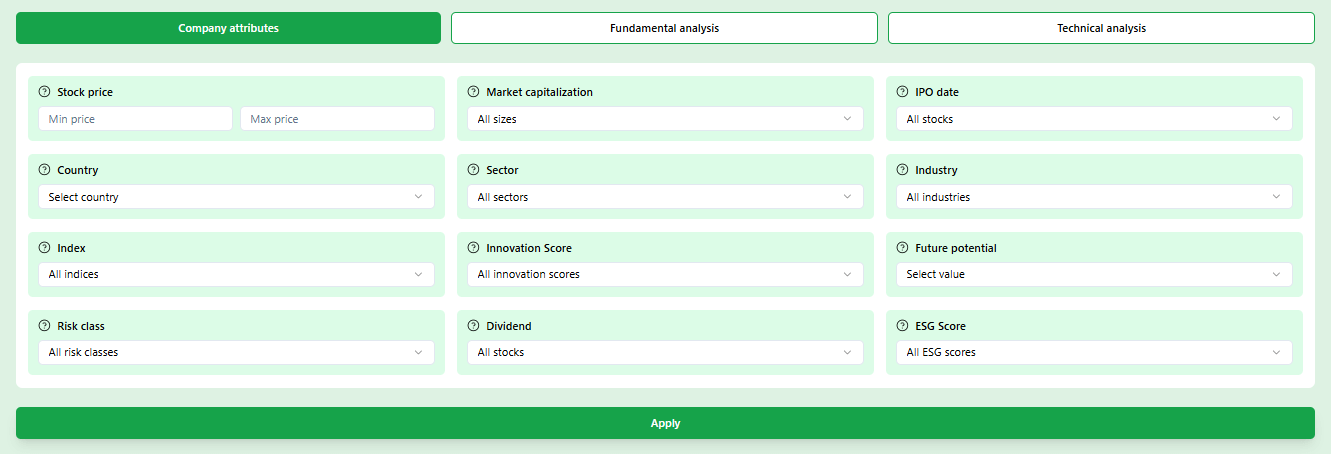
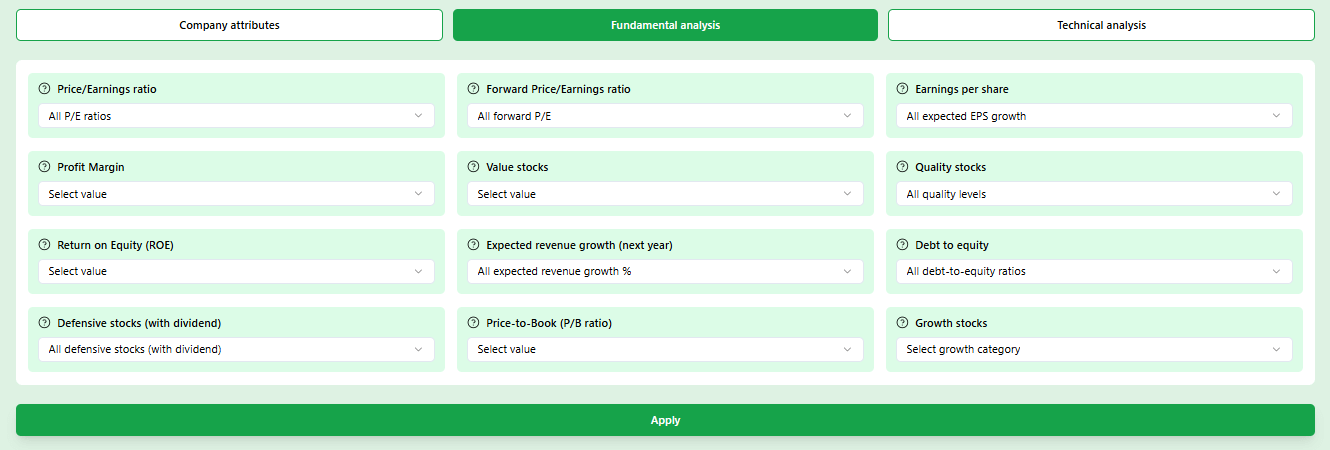
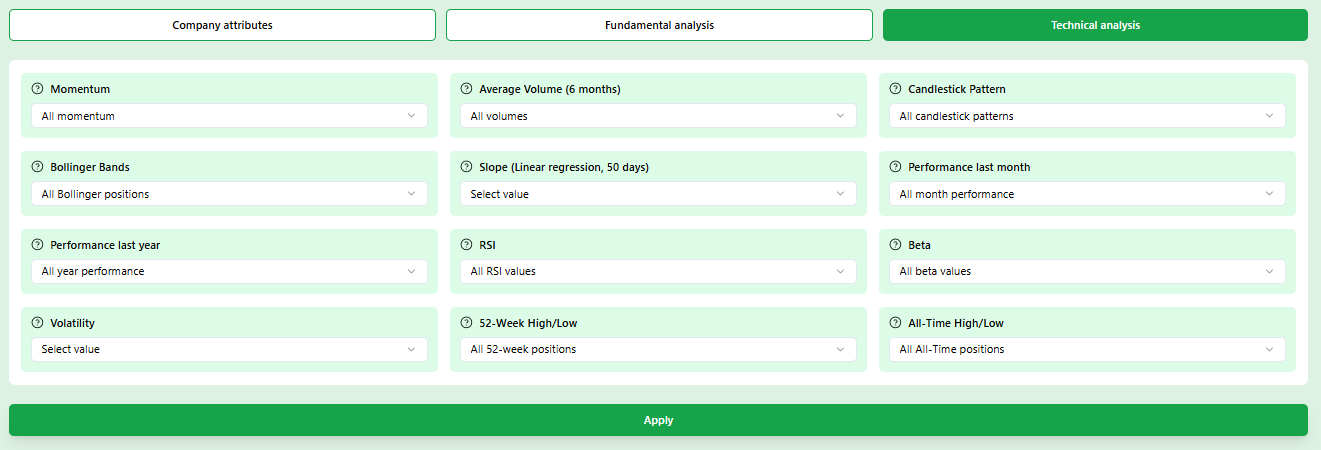
Beyond the guided questionnaire, Belegget also gives you a manual screener with over 36 filter criteria. You can combine P/E ratios, market cap ranges, dividend yields, momentum signals and more. As your knowledge grows, the tool grows with you.
Fundamental filters
Revenue growth, profit margins, cash flow, debt levels and more
Technical filters
RSI, 52-week highs, momentum and price performance indicators
Quick presets for beginners
Ready-made filter combinations like 'Dividend focus' or 'Growth stocks' that you can apply with one click
See for yourself how the screener works
Register for free and run the smart questionnaire. Within minutes you'll have a personal list of stocks that match your goals, built from verified financial data.
✓ No credit card required ✓ Instant access ✓ Android and iOS
Five things that matter most when choosing an investing app as a beginner
These are the areas where most apps fall short for people who are just starting out. Here's what they look like in practice.
Filtering that speaks your language, not the market's
The biggest obstacle for most new investors isn't access to data. It's the assumption that you already know what to do with it. A raw stock screener with 50 unlabeled sliders doesn't help someone who's still figuring out the difference between revenue and profit.
The best apps for beginner investors translate intent into criteria. Instead of asking you to set a P/E ratio between 10 and 15, they ask what kind of company you're looking for and handle the translation themselves. In Belegget, the smart questionnaire does exactly this. You pick your direction, the filter logic runs in the background, and you see stocks that match. It's the same underlying data, just made accessible.
Data you can actually trust
A lot of beginner investing apps pull from free or community-sourced data, which sounds fine until you notice that a company's revenue figure hasn't been updated in six months or that key metrics are simply missing. This matters because your decisions are only as good as the information behind them.
Belegget sources its financial data from EODHD, a professional financial data provider used by investment platforms and analysts. Coverage spans thousands of listed companies across global exchanges. Fundamentals, price data, and key ratios are updated daily. You can see when data was last refreshed and where it comes from. For a beginner building their first stock list, knowing that the numbers are current and from a reliable source removes a real source of uncertainty.
Sector and region filters that actually narrow things down
Most beginners start with companies they recognize or industries they understand. That's a perfectly reasonable way to begin. The problem is that without sector filtering, you're either scrolling through thousands of companies or relying on someone else's curated list with no idea how it was built.
Sector and region filters give you a manageable scope. Want to look at European healthcare companies, or US technology stocks with a market cap above five billion? You set those parameters and the screener does the work. This is where the best apps for beginner investors outperform generic financial news: they don't just show you what's trending, they show you what fits your actual criteria. And as you learn more, you can refine those criteria to reflect your growing understanding of what you're looking for.
Dividend filtering for investors who want income alongside growth
Dividend investing is one of the more intuitive starting points for beginners because the return is visible and predictable. A company pays you a portion of its profits at regular intervals, and you can filter for stocks based on their current yield or the consistency of those payments over time.
What makes this genuinely useful in a screener is the ability to combine dividend criteria with stability filters. A 10% yield from a company with declining revenue and increasing debt is a very different proposition than a 3% yield from one that's grown its dividend every year for a decade. Belegget lets you layer these criteria so you're not just chasing yield numbers but actually assessing whether a company can sustain its payouts. That distinction is something a lot of platforms don't make easy for beginners to see.
A watchlist that becomes your personal research base
Finding interesting stocks is one thing. Keeping track of them without losing your notes, your reasoning, or the context you had when you first looked at them is another. Most beginners end up with browser bookmarks, screenshots, or a spreadsheet that slowly becomes unmanageable.
A proper watchlist inside a screener keeps everything connected. When you save a stock in Belegget, it stays alongside the financial data that was relevant when you added it. You can organize by theme, come back weeks later and see where the metrics stand now, and compare your original assessment with the current numbers. Over time, this becomes genuinely valuable — and it's one of the features that separates the best apps for beginner investors from platforms that treat every session as if you're starting fresh.
Start building your first stock list today
The best apps for beginner investors give you structure, reliable data, and a way to build on your research over time. That's exactly what Belegget is built for. Use the guided questionnaire to find stocks that fit your goals, then track them in your personal watchlist.
Common questions about investing apps for beginners
Practical answers to what people actually ask when getting started.
More guides for investors getting started
These guides go deeper into specific topics that come up naturally after you've run your first stock search.
How do I find good stocks?
A structured approach to identifying quality companies rather than just reacting to news or tips.
Easy to use stock screener
What makes a stock screener actually practical to use and how to get the most out of one without overcomplicating it.
Stock volatility screener
How to use volatility as a filter criterion and what it tells you about the risk profile of a stock.