Price divided by next twelve months earnings estimate. Lower means the market expects less growth or has priced in bad news.
Enterprise value relative to operating profit before depreciation. Useful across different capital structures and often preferred over P/E.
Market cap divided by book value of equity. Used by Graham to find assets priced below replacement cost.
Net income as a percentage of shareholder equity. High ROE over many years signals a durable competitive advantage.
Total debt divided by shareholder equity. High leverage amplifies risk and makes valuation more sensitive to interest rate changes.
Net income as a percentage of revenue. Durable high margins often indicate pricing power or a structural cost advantage.
Screen 25,000 companies by forward P/E, EV to EBITDA, return on equity and margin of safety thresholds. The intrinsic value stock screener cuts the global universe down to a list worth examining.
✓ Instant access · ✓ No credit card required
Run the intrinsic value stock screener now
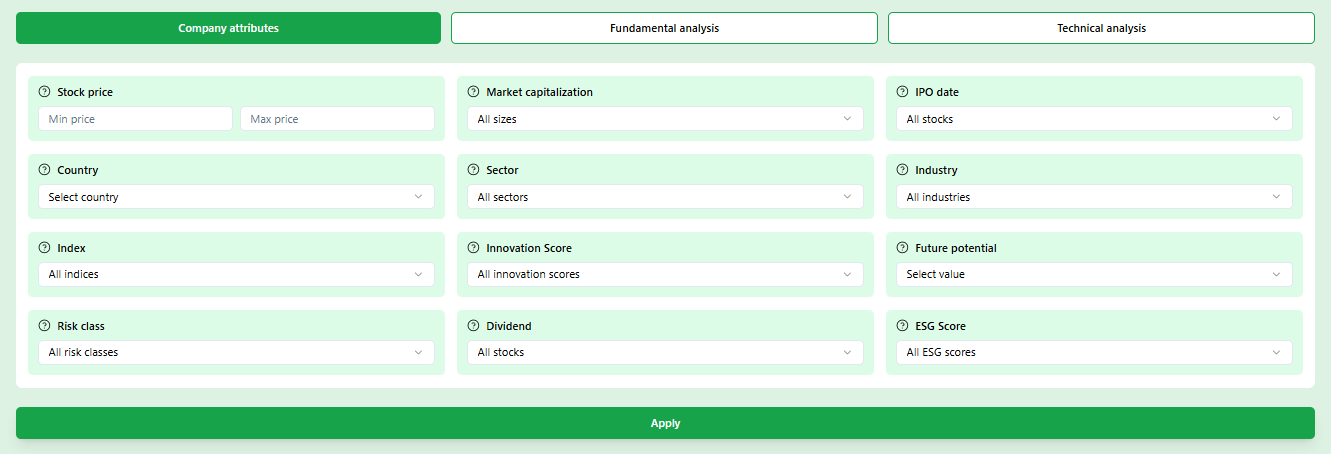
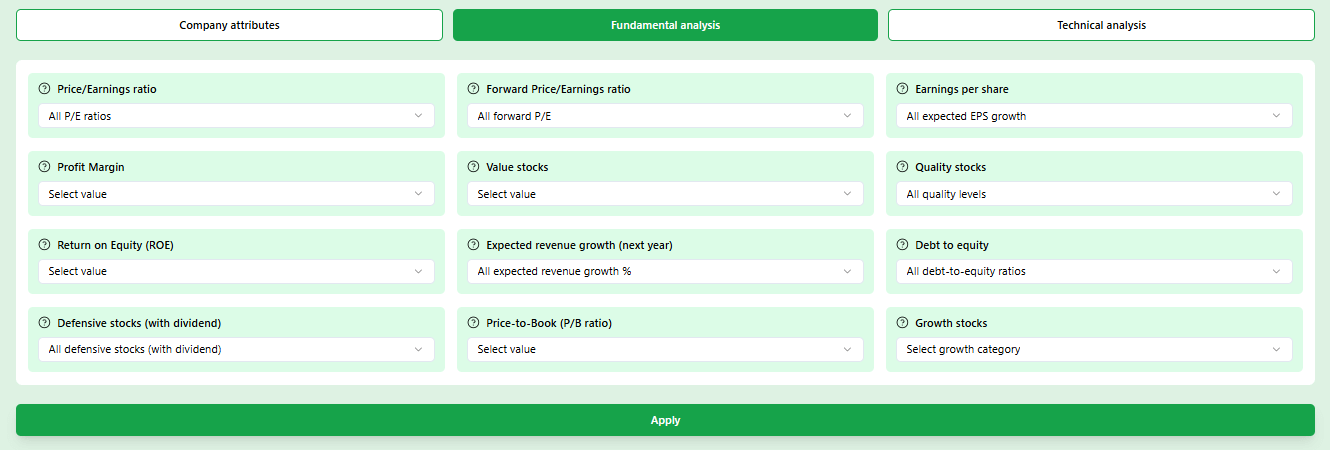
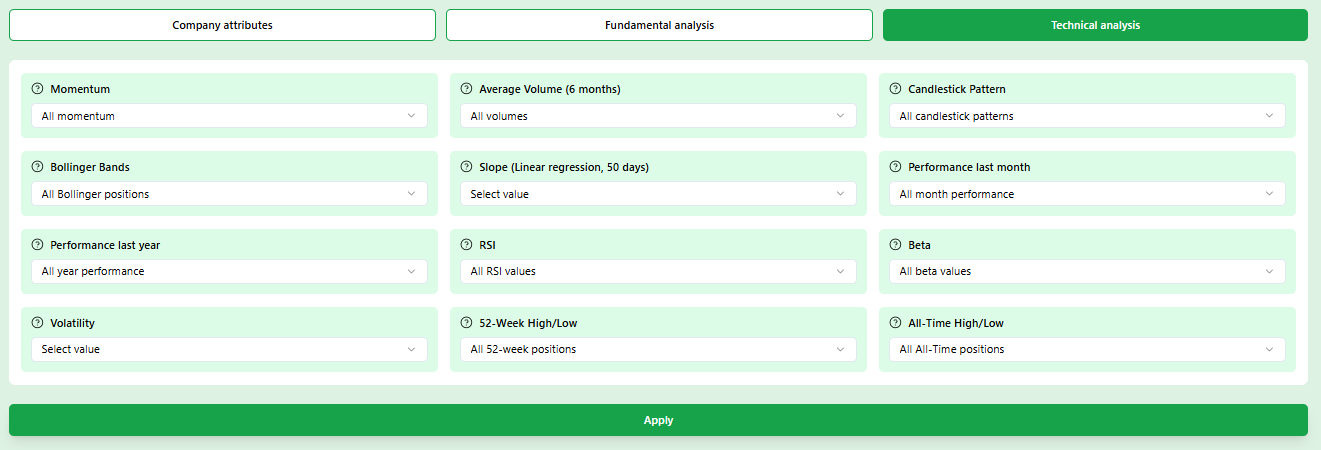
All filters in one flat list. Set your thresholds for valuation and quality in seconds and see which companies pass across 52 countries.
What a business is worth, independent of its share price
The gap between price and intrinsic value is where investment returns come from.
Discounted cash flow
Earnings multiple
Asset value
Intrinsic value: the anchor that separates investing from speculation
Every share price is an opinion. The person selling believes they are getting fair compensation; the person buying believes they are getting more than they pay. Intrinsic value is the theoretical anchor that both sides implicitly argue about, even when they do not use the term.
Buffett has described intrinsic value as the discounted value of cash that a business can take out over its remaining life. That definition is precise in theory and impossible to calculate exactly in practice. Future cash flows are estimates. The discount rate is a judgment call. The business lifespan is unknowable.
The practical implication is that intrinsic value is a range, not a number. An investor who estimates a stock is worth between $80 and $100 and sees it priced at $58 has a clearer picture than the investor who has no estimate at all. The intrinsic value stock screener gives you a way to identify where that gap between price and estimated value might exist across thousands of companies simultaneously.
Valuation thresholds that reflect how businesses are actually priced
Forward P/E, EV to EBITDA and return on equity are not arbitrary choices. They are the ratios that experienced analysts consult first when estimating whether a company is trading at a discount. The intrinsic value stock screener lets you apply them simultaneously across 25,000 companies.
Valuation ratios
Forward P/E, EV to EBITDA and P/B in one place
Quality overlay
ROE, margins and debt filters to weed out cheap-for-a-reason stocks
Premium scoring
Value score and quality score as shortcut composite metrics
Technical confirmation
RSI and 52-week range to check whether the price has already moved
What the intrinsic value stock screener gives you that a general screener does not
Fair value orientation
Every filter is selected because it relates to whether the price reflects the business's earnings power, not just momentum or market sentiment.
Quality filter built in
Screening by valuation alone finds value traps. Adding ROE and margin filters surfaces companies that earned their way to a cheap multiple.
52 countries included
Intrinsic value opportunities appear more often in European and Asian markets than in overpriced US large caps. The full database is searchable.
Under three minutes
Set your thresholds, apply, review the list. No spreadsheet, no data subscription, no manual ratio lookup across different platforms.
How intrinsic value investing actually works
The ideas behind the intrinsic value stock screener: what the concept means, how analysts apply it, and where investors consistently go wrong when using it.
Ready to screen for stocks trading below fair value?
The intrinsic value stock screener covers 25,000 companies in 52 countries. Free account, no credit card required.
Valuation ratio reference for intrinsic value analysis
What each ratio measures and the thresholds that signal a stock may be priced below its reasonable fair value. Green does not mean buy, it means the first test is passed.
About Belegget
Belegget was built on the idea that finding quality companies should not require a Bloomberg terminal or a finance degree. The platform gives individual investors access to the same screening depth that professional analysts use daily, without the complexity or cost.
Questions about intrinsic value and how the screener works
Practical answers for investors new to fair value analysis and those looking to sharpen their approach
Related screener guides
Guides that cover related approaches to finding stocks worth researching, from broad value filters to growth criteria and easy-to-use tooling
Value Stock Screener
Apply classic value filters to global markets and identify companies trading at a discount to fundamental metrics.
Growth Stock Screener
Find companies expanding revenue and earnings at above-average rates, screened across sectors and geographies.
Easy to Use Stock Screener
A practical starting point for investors who want results quickly without configuring dozens of individual filters.