Margin of safety built in
Graham and Buffett methodology
25,000 stocks across 52 countries
Screen in under three minutes
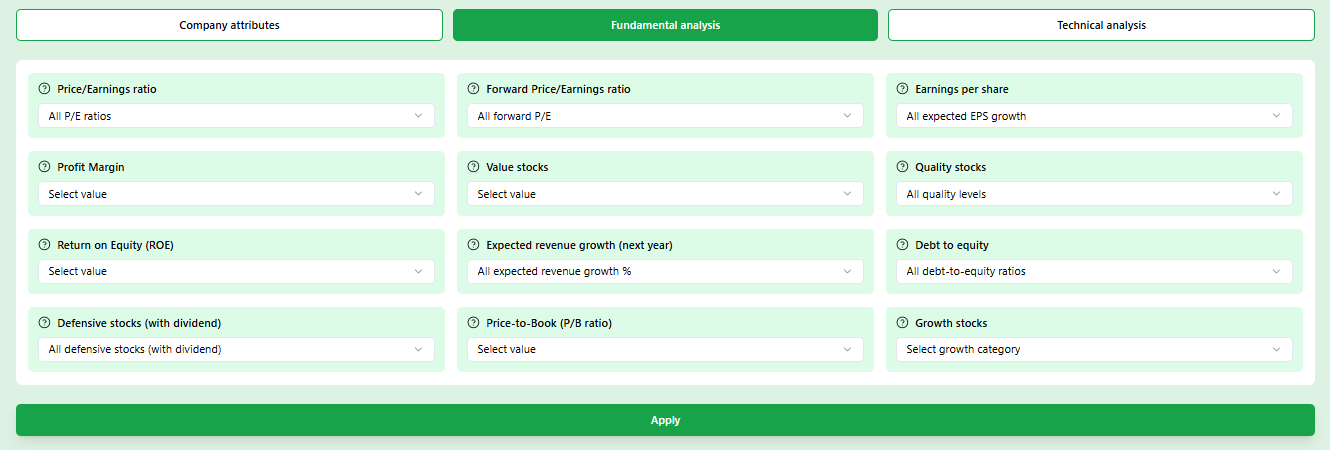
Price relative to annual earnings per share. Graham used below 15 as his upper threshold for value stocks.
Current share price relative to net asset value per share. A P/B below 1 means you are paying less than the accounting value of the assets.
Total debt relative to shareholder equity. High leverage amplifies losses in downturns. Graham preferred below 0.5.
Net income relative to shareholder equity. Buffett used consistent ROE above 15% as a sign of durable competitive advantage.
Net income as a percentage of revenue. Stable margins over time indicate pricing power and cost control.
Price relative to next year's expected earnings. Useful for seeing whether current valuation assumes significant earnings growth.
Annual dividend relative to share price. Graham viewed consistent dividends as evidence of earnings quality and management discipline.
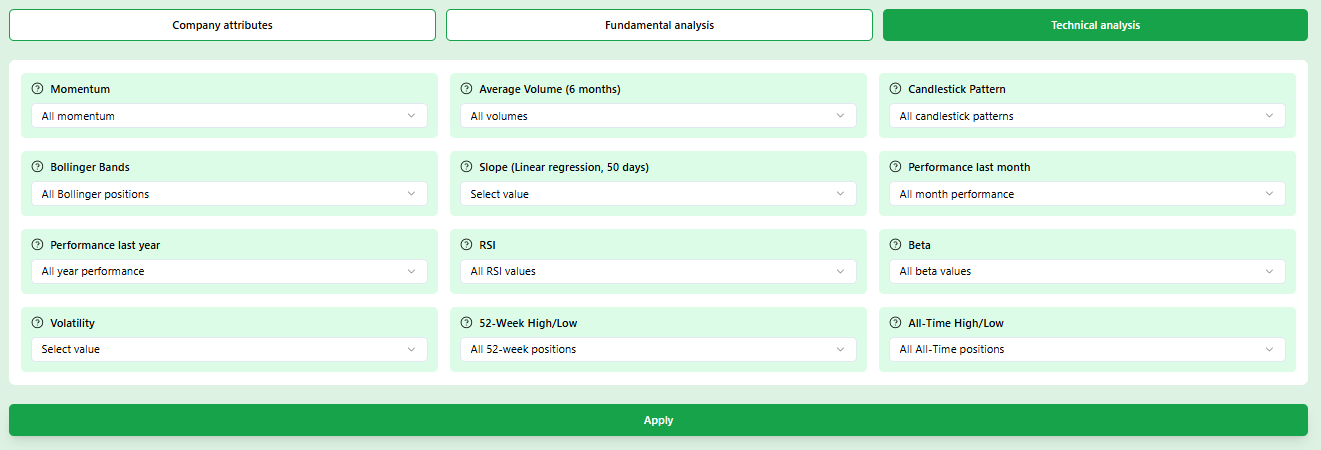
Where the current price sits relative to the year's high and low. Deep value candidates often cluster near their 52-week lows.
Relative Strength Index between 0 and 100. Value investors sometimes use RSI to confirm a stock has been oversold before entry.
Apply Benjamin Graham's criteria and Warren Buffett's quality filters across 25,000 companies in 52 countries. Set your margin of safety threshold and let the screener do the first pass.
✓ Instant access · ✓ No credit card required
Try the value investing stock screener live
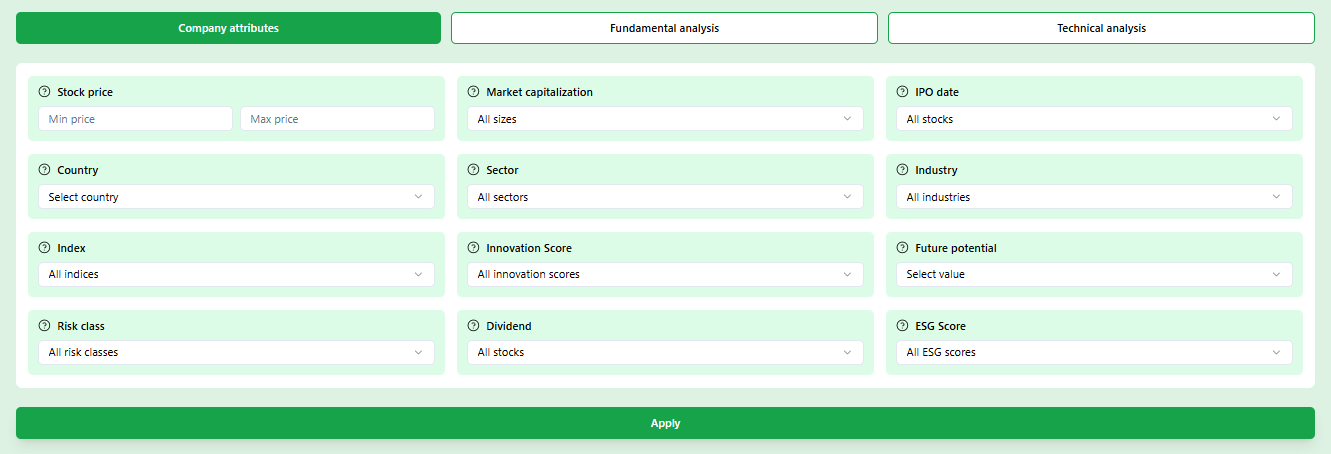
All filters in one flat list. Adjust any threshold and the value investing stock screener updates the results instantly across 25,000 companies.
Professor at Columbia Business School. Mentor of Warren Buffett.
Security Analysis
The Intelligent Investor
The man who turned stock picking into a discipline
Benjamin Graham began his career on Wall Street in 1914, during a period when investing was largely speculation dressed up as analysis. What he observed was that most people bought stocks the way they bought lottery tickets: on hope, rumour and the direction prices had recently moved. Graham believed there was a better way.
His first major book, Security Analysis, co-authored with David Dodd in 1934, laid out a systematic framework for evaluating businesses rather than just their share prices. The Intelligent Investor followed in 1949 and introduced the concept of Mr Market: a fictional business partner whose mood swings between fear and euphoria, creating mispricing that a patient investor can exploit.
Graham taught at Columbia Business School for decades. One of his students was Warren Buffett, who later described The Intelligent Investor as the best book ever written on investing. Buffett took Graham's principles and adapted them by placing greater emphasis on business quality, but the foundation, buying at a discount to what something is actually worth, has never changed.
Answer a few questions and get a focused value stock list
The Smart Filter translates your investment approach into a concrete set of criteria. Tell it how you think about valuation, how much margin of safety you need, and how patient you are. It sets the filters and generates the list.
Valuation philosophy
Graham-style deep value or Buffett-style quality at a fair price
Margin of safety threshold
Set how far below fair value the stock needs to trade before you act
Holding period
Short patience or multi-year commitment changes which stocks fit
Graham's original thresholds, applied across global markets
P/E below 15, P/B below 1.5 and a clean balance sheet. These criteria were designed to find companies where the price already reflected bad news, leaving room for recovery. The value investing stock screener lets you apply them to 25,000 companies at once.
Classic valuation filters
P/E, P/B, EV/EBITDA and free cash flow yield in one place
Quality layer on top
ROE, profit margin and earnings consistency to avoid value traps
Technical confirmation
RSI and 52-week position to check whether the price is already moving
Build and save your filter set
Store your criteria and rerun them each week with one click
Value investing ratio reference
What each ratio measures and the thresholds Benjamin Graham and Warren Buffett have used historically. Green does not mean buy, but it means the number passes the first test.
How value investing works in practice
The philosophy behind the value investing stock screener. What Graham and Buffett actually meant, why certain criteria matter, and how to use them without repeating the mistakes most investors make.
Ready to apply Graham's criteria to real stocks?
The value investing stock screener covers 25,000 stocks across 52 countries, with all the classic Graham and Buffett criteria in one place. Free account, no credit card.
Built for value investors who want results, not complexity
The screener is organised around the metrics that actually matter for finding undervalued businesses
About Belegget
Belegget was built around one observation: finding quality stocks does not have to involve hours of manual research. The screener gives individual investors access to the same filtering logic that professional analysts use, without requiring a Bloomberg terminal or a finance degree.
Questions about value investing and the screener
Practical answers for investors who are new to screening and those who have been doing it for years
Related value investing guides
Guides that complement the value investing stock screener with deeper approaches to finding undervalued companies and estimating what they are actually worth
Undervalued Stock Screener
Find stocks trading below fair value using a dedicated set of undervaluation filters across global markets.
Intrinsic Value Stock Screener
Screen by intrinsic value estimates and see how far the current price sits from what the business is calculated to be worth.
Best Stock Picking Tools
A practical overview of the most useful tools for individual investors researching stocks independently.
Start finding stocks that meet Graham's criteria today
Free account, instant access, no credit card. 25,000 companies filtered by the metrics that value investors actually use.