The apparel industry includes a wide range of companies, from global brands to smaller niche players. Identifying which businesses deserve closer attention requires looking beyond the headlines. This guide explains what to look for in clothing stocks and how to use a stock screener to quickly find companies that match your investment criteria.
What separates strong clothing stocks from the rest
Not every fashion company that shows up in a screener deserves your attention. These are the qualities that tend to show up consistently in clothing stocks worth holding.
Brand moat
Consumers pay more for a label they trust. Pricing power protects margins even when input costs rise. Look for brands that have held or grown their gross margin over multiple years.
Geographic diversification
A clothing company earning revenue across several continents is less exposed to any single economic slowdown. Check what share of revenue comes from outside the home market.
Inventory discipline
Unsold seasonal stock forces discounting, which compresses margins fast. Companies with inventory turnover above four times per year manage this risk significantly better.
Multiple product lines
Companies that sell across clothing, footwear, and accessories reduce dependence on a single category. Category diversification also creates more opportunities for upselling.
Free cash flow
Strong cash generation lets clothing companies invest in new collections, marketing, and store expansion without relying on debt. It also funds share buybacks and dividends.
Customer loyalty
Repeat purchasers lower customer acquisition costs and stabilize revenue. Brands with a loyal following can grow without spending heavily on promotions every quarter.
Answer a few questions and get a personalized list of clothing stocks
Most stock screeners dump a list on you and expect you to know what to do with it. The Smart Filter works differently. It asks you what you actually care about and builds the list around your priorities.
What type of clothing company
Premium brand, high-volume retailer, luxury label or sportswear — you decide which segment fits your thesis.
Your holding period
Short-term positioning and long-term ownership lead to very different stock selections. The filter accounts for that.
Income or growth priority
Dividend-focused clothing stocks and high-growth apparel names sit in very different valuation ranges.
Filter directly on sector, industry and financials
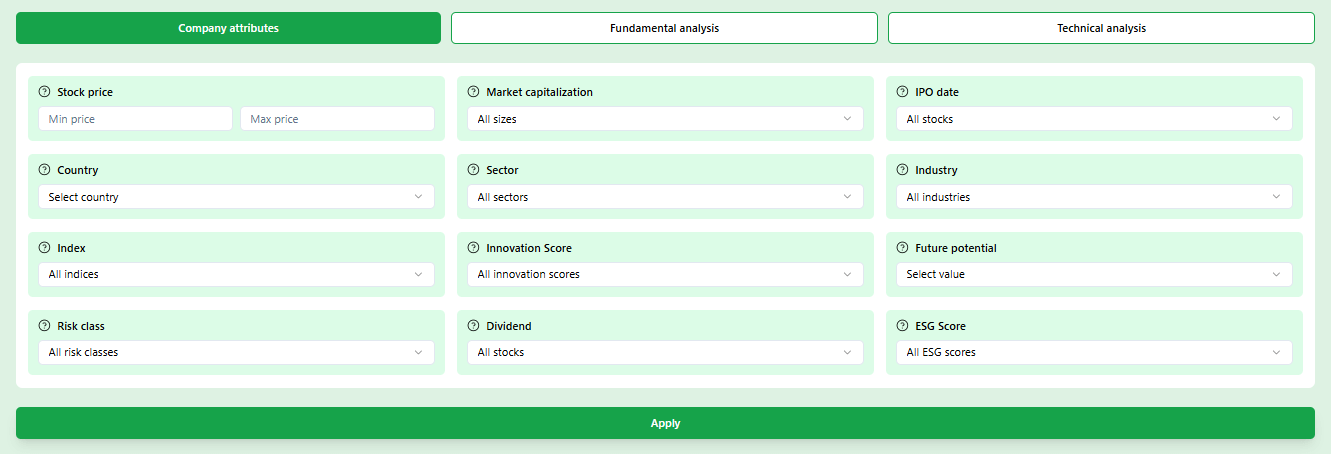
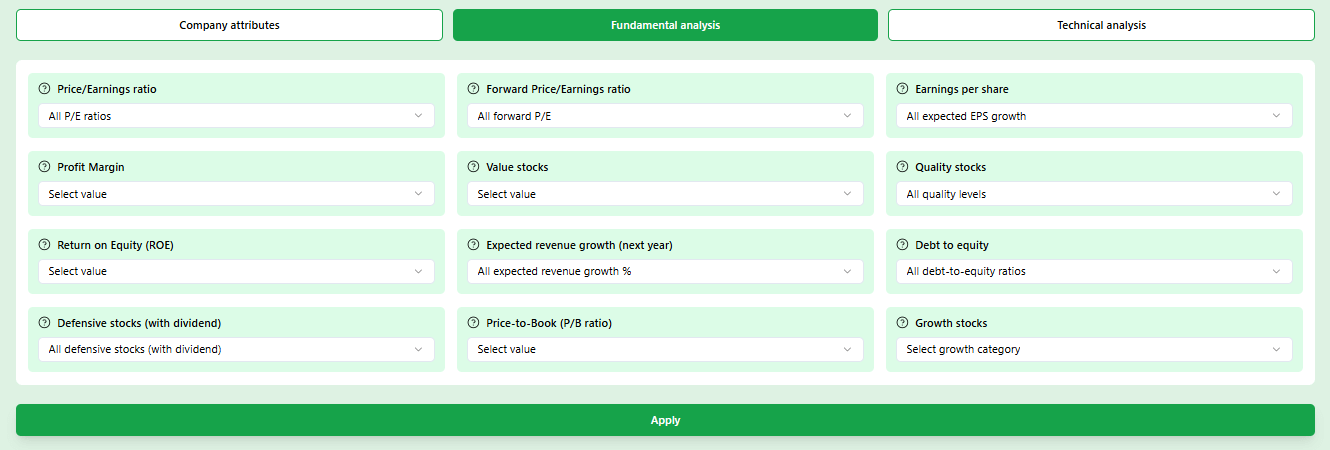
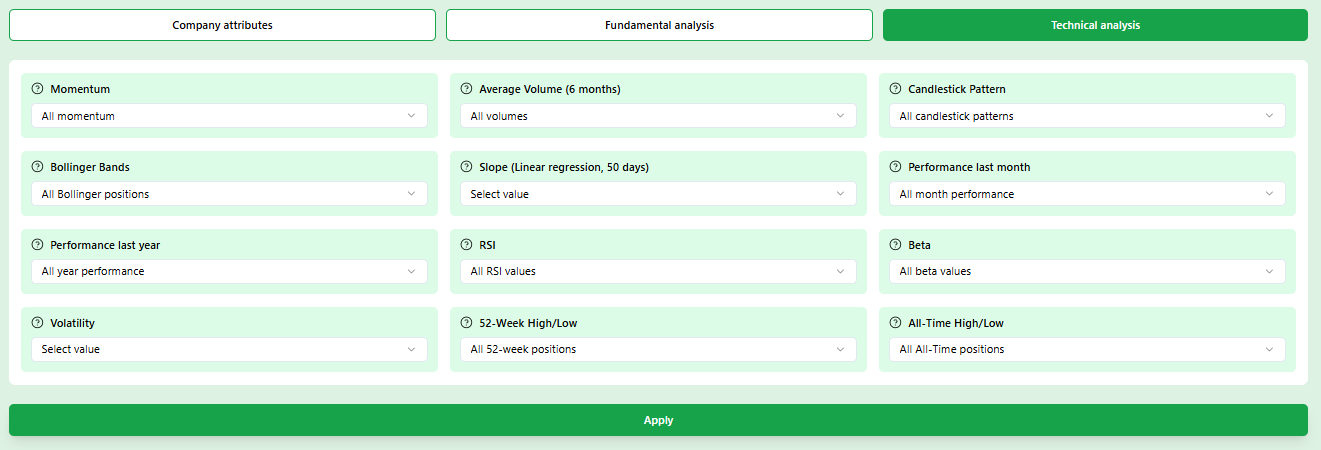
Prefer to build your own search? The manual filter gives you full control. Select Consumer Discretionary as the sector, narrow to Apparel as the industry, then layer on market cap, dividend yield, revenue growth and more.
Sector and sub-industry filtering
Go straight to clothing, footwear or accessories without sorting through irrelevant sectors first.
Combine up to seven filter categories
Stack sector, market cap, margin, growth rate, dividend, region and momentum together in one search.
Save the stocks you want to track
Add any clothing stock to your watchlist and follow it over time without starting your search again.
Ready to find clothing stocks worth investing in?
Create a free account, answer a few questions, and get your first personalized list of apparel stocks based on your investment preferences in just a few minutes.
✓ No credit card required · ✓ Instant access · ✓ Free basic features
How to research clothing stocks the right way
Finding good clothing stocks starts with knowing what to look at. Here is a practical framework covering the five areas that matter most when evaluating apparel companies.
Start with the sector filter to isolate clothing companies
The first step in finding good clothing stocks is narrowing your universe. Rather than scrolling through thousands of tickers across every sector, a screener lets you jump straight to Consumer Discretionary and then filter down to Apparel, Footwear or Accessories as a sub-industry. This single step already removes most of the irrelevant results.
Once you are looking at only clothing companies, you can start comparing them on metrics that actually matter for the industry: gross margin consistency, brand diversification, and whether revenue growth is coming from new markets or simply from raising prices. The sector filter is the entry point to a focused and productive research session.
Revenue trends and margins reveal the real strength of apparel brands
Clothing companies that grow revenue while maintaining or expanding their gross margin are typically the ones with genuine pricing power. This combination is rarer than it sounds. Many apparel businesses grow the top line only by discounting, which masks underlying brand weakness. Filtering for gross margin above 45% alongside consistent revenue growth over three or more years is a solid starting point.
Look beyond revenue to operating margin as well. Clothing companies spend heavily on design, marketing and distribution. Those that manage these costs while still growing are operationally disciplined. EBITDA margin trends over five years tell a clearer story about management quality than a single year of results ever could.
Regional filters show where growth in clothing stocks is actually coming from
The geography behind a clothing company's revenue matters more than most investors realize. A brand that earns 70% of its sales in one country is inherently more exposed to regional economic risk than one spread across four or five markets. The most durable apparel businesses tend to generate meaningful income from North America, Europe and at least one growing Asian market simultaneously.
Emerging market exposure adds growth potential but also currency and political risk. Filtering by region in Belegget lets you decide how much of each you want. If you prefer stability, concentrate on companies with strong European or North American revenue. If growth is the priority, look for brands actively expanding in Southeast Asia or the Middle East.
Market cap tells you which type of clothing stock you are looking at
Large-cap clothing companies, typically valued above ten billion dollars, have usually already built their global brand and distribution. They tend to be slower-growing but more stable, often paying dividends and buying back shares. Mid-cap apparel companies in the one to ten billion dollar range are often in a phase of international expansion or category growth, which creates more upside but also more volatility.
Small-cap clothing stocks below one billion dollars carry the highest risk but occasionally represent brands in the early stages of scaling their identity. These require more due diligence because brand value at this size is often untested across economic cycles. The market cap filter lets you choose which part of the spectrum fits your risk comfort.
Dividend filters help identify income-generating clothing stocks
Investors who want recurring income from their apparel holdings should check dividend yield alongside payout consistency. A clothing company with a five-year track record of increasing its dividend is a very different proposition than one paying a high yield for the first time. Consistent payers tend to have more stable business models and stronger free cash flow.
The dividend filter in Belegget shows both current yield and payment history. You can sort by yield, filter for companies with consecutive years of increases, or simply exclude non-dividend payers if income is your primary objective. Combined with the sector filter, it narrows your clothing stock list to exactly the type of company that fits an income-oriented portfolio.
Why investors use Belegget to research clothing stocks
The screener is built around the way investors actually think about stock selection, not around raw data dumps.
Apparel sector focus
Fundamental data that matters
Global coverage
Updated daily
What to expect from each clothing stock segment
The apparel market is not one thing. Fast fashion, premium lifestyle and luxury each behave very differently as investments. This overview helps you figure out where to look first.
Quick checklist before adding a clothing stock to your watchlist
Frequently asked questions about clothing stocks
Specific answers to the questions that matter when researching apparel companies
More ways to find stocks with Belegget
Once you have explored clothing stocks, these guides help you discover other stock types using the same screener — each with a different search focus.
Simple Stock Screener
Find out how to use a stock screener without any prior experience. A practical starting point for investors who are new to filtering stocks.
Mobile Stock Screener
Research stocks wherever you are. See how Belegget works on mobile and why a phone-friendly screener makes a real difference for your workflow.
Value Stock Screener
Look beyond the surface and find companies trading below their intrinsic value. A guide to value investing filters and what to check before you buy.