P/E Within Your Sector
Free Cash Flow as a Signal
Value Trap Detection
A Clear Five-Step Process
Many investors start with valuation metrics such as the P/E ratio, but a single number rarely tells the whole story. This guide explains the key metrics to evaluate, how to interpret them in context, how to identify potential value traps, and how a stock screener can help you quickly narrow thousands of stocks down to a manageable shortlist.
✓ No credit card required · ✓ Instant access
How a stock screener finds undervalued stocks for you automatically
Not sure where to start? The Smart Filter guides you through a short series of questions about your investment goals and risk tolerance. Based on your answers, it runs the stock screener automatically and delivers a personalized shortlist of undervalued stocks that match your profile. No complicated settings and no financial jargon required.
Questions that adapt to your answers
Each step narrows the field based on what you told us in the previous one
Your profile, not a generic list
The result reflects your risk tolerance and goals, not a one size fits all ranking
Done in under two minutes
Faster than reading a single company's annual report, with results across thousands of stocks
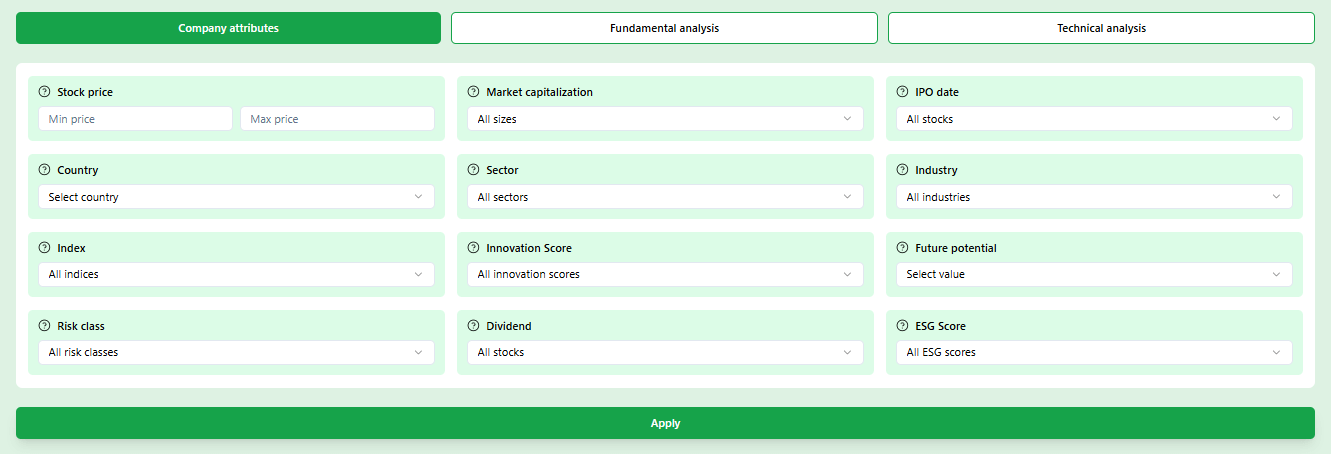
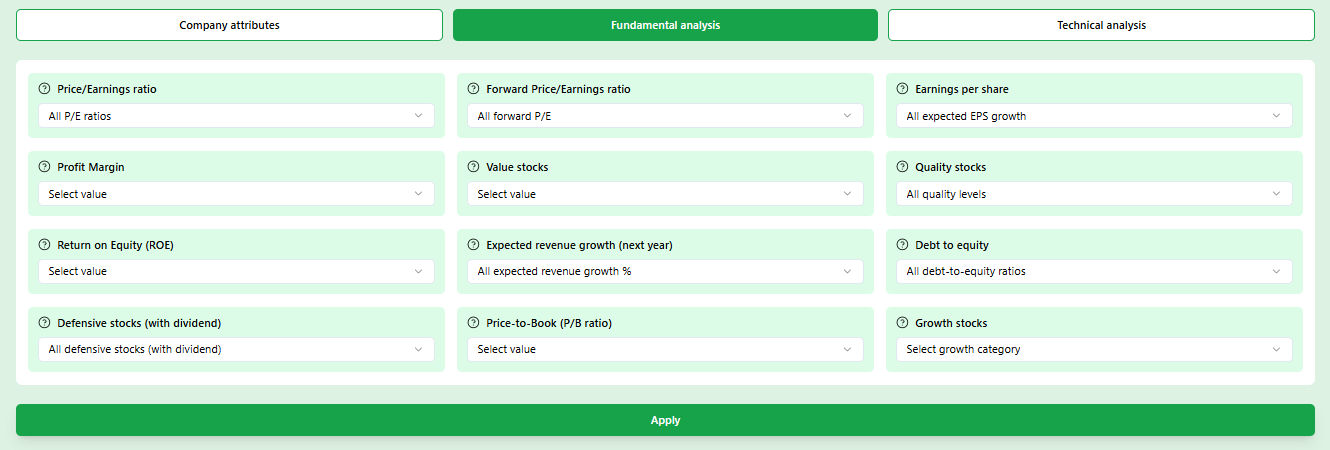
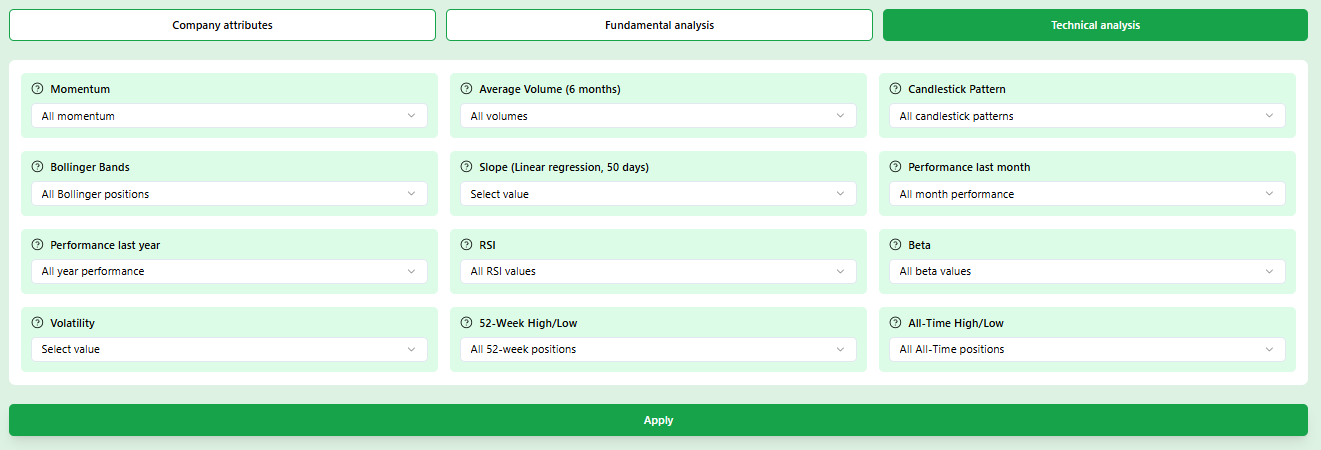
Build your own strategy to find undervalued stocks with advanced filters
If you prefer to set the parameters yourself, Belegget gives you over 36 filters across fundamentals, technicals and company characteristics. Combine P/E below sector median with positive free cash flow and low debt — the stock screener returns only the undervalued stocks that clear every hurdle you set.
36 professional filters
Valuation ratios, revenue trends, technical indicators, sector and region
Results update in real time
Every filter change immediately refreshes the list of qualifying stocks
Save stocks to your watchlist
Keep track of candidates and monitor them as market conditions change over time
Ready to find undervalued stocks with a screener?
Create a free account and run your first screen in minutes. No credit card, no complicated setup.
✓ No credit card required · ✓ Instant access · ✓ Free core features
What makes this approach to finding undervalued stocks different
Using a stock screener to find undervalued stocks requires more than filtering on a low P/E. Here is what this guide and the Belegget screener focus on.
How to use a stock screener to find undervalued stocks in five steps
Below you will find the complete framework. Each step builds on the previous one. By the end you have a structured shortlist of undervalued stocks that clear both the valuation and quality hurdles — and none of the traps.
Why a stock screener needs sector context to find truly undervalued stocks
A P/E ratio of 12 in the banking sector signals something very different from a P/E of 12 in software. Banks typically trade at lower multiples because earnings are more predictable and growth is slower. Software companies trade higher because investors price in future growth. If you use a stock screener to find undervalued stocks without adding sector context, you end up comparing apples with oranges — and miss most of the genuine opportunities.
The right approach is to compare a company's P/E against the median of its direct peers — companies in the same industry with a similar business model. A technology stock at P/E 22 when its sector trades at 35 on average is statistically cheap. A utility at P/E 22 when its peers trade at 14 is expensive. This single shift in perspective eliminates a large share of false positives that beginner screeners produce.
The P/B ratio: when it reveals genuinely undervalued stocks
The price to book ratio compares the stock price with the company's net asset value per share. A P/B below 1.0 means the market is valuing the company at less than what its assets are worth — a classic signal of undervalued stocks in asset-heavy industries. For banks, insurers and real estate investment trusts this is a meaningful and reliable screener criterion, because the assets are tangible, audited and liquid.
For a software business or a consumer brand with minimal physical assets, P/B is almost irrelevant. The value of such companies lies in intellectual property, subscriber relationships and brand reputation — none of which appears clearly on a balance sheet. Applying P/B to a SaaS company and concluding it is expensive would be a mistake. Understanding when to use which metric, and when not to use it, is what separates informed screening from noise.
Free cash flow yield: the signal serious stock screener users rely on
Reported earnings can be influenced by depreciation schedules, one-off write-offs and management decisions about when to recognize revenue. Free cash flow — the actual cash a business generates after paying for operations and capital expenditure — is far harder to manipulate. This is why institutional investors often build their positions around FCF yield rather than earnings multiples.
FCF yield is calculated by dividing annual free cash flow by market capitalization. A yield above 5% is generally considered attractive, meaning the company is generating meaningful cash relative to what the market is asking you to pay. When you combine a below-sector P/E with a strong FCF yield, you have a company that is cheap on two independent measures — and that is where the most interesting undervaluation cases tend to cluster.
Value traps: what a stock screener alone cannot filter out for you
A stock can be cheap on every valuation metric and still be a terrible investment. These are called value traps — companies whose low price reflects genuine deterioration rather than temporary market pessimism. Identifying them before you buy is one of the most important skills in value investing.
The clearest warning signs are persistent revenue decline over multiple years, shrinking profit margins, a heavy debt load in an environment of rising interest rates, and repeated downward revisions to analyst earnings forecasts. A screener finds candidates — the companies that clear your valuation thresholds. But checking these four signals before adding a stock to your watchlist is what keeps traps out of your portfolio. A great screener gives you the starting point. Due diligence gives you the conviction.
The complete process: how to use a stock screener to find undervalued stocks
Once you understand the individual metrics, the full screening process takes less time than you might expect. Here is how the five steps look in practice:
Choose a sector, region and market cap range. Screening 5,000 companies at once is overwhelming. Narrowing to 400 gives you a workable starting field.
P/E below the sector median, P/B below 1.5 where relevant, FCF yield above 5%. These three combined already filter out a large majority of stocks.
Revenues stable or growing over the past three years. Debt at manageable levels relative to earnings. A company that passes valuation and quality filters simultaneously is a serious candidate.
Revenue trend direction, margin trend, recent earnings revisions. If two or more signals are red, move on to the next candidate.
Add qualifying stocks to your Belegget watchlist. Most undervalued situations take months to be recognized by the broader market. Patience is part of the process.
Use this stock screener to find undervalued stocks right now
The Belegget screener lets you run every step of this framework in one place — sector filters, valuation ratios, cash flow metrics and a watchlist to track your undervalued stock shortlist over time.
Frequently asked questions
Everything you need to know about using a stock screener to find undervalued stocks
Continue your value investing research
Explore these related guides to deepen your understanding of undervaluation, intrinsic value and value-focused screening strategies.
Undervalued Stock Screener
Access the actual screener and start filtering for undervalued stocks right now. Set your parameters and get a shortlist in minutes.
Value Investing Stock Screener
A deeper look at value investing filters and how to combine classic Buffett-style metrics with modern screening tools.
Intrinsic Value Stock Screener
Learn how to estimate what a stock is actually worth and use intrinsic value calculations alongside your screener results.